‘There is no other scientist quite like Francis Halzen’
Leaders across the state, country and world pay tribute to the UW–Madison professor and winner of the 2026 Nobel Prize in physics.
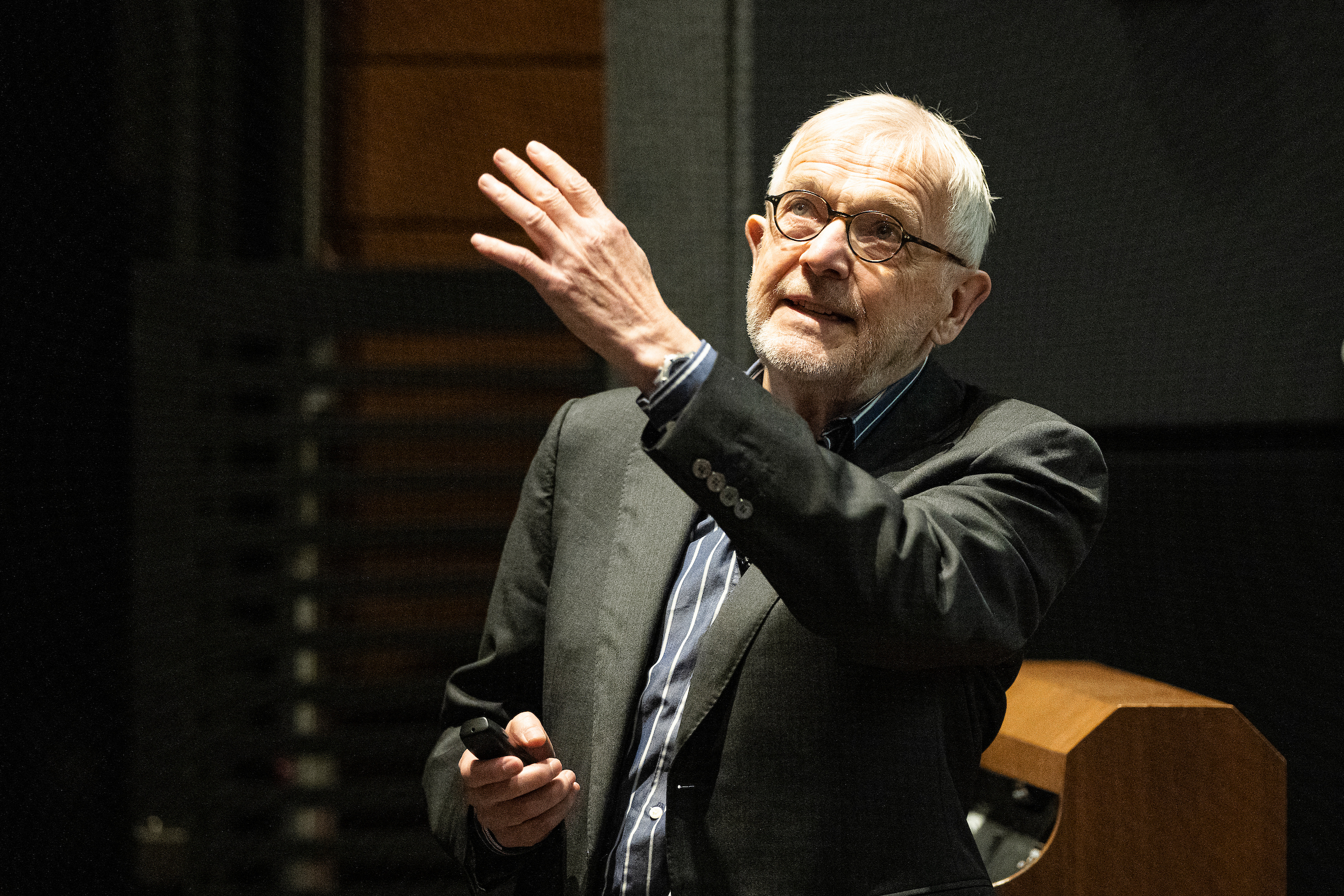
Following the announcement on Oct. 6 that Francis Halzen had won the 2026 Nobel Prize in physics, tributes to the University of Wisconsin–Madison professor poured in from across the university, state, country and world. Prominent figures praised Halzen’s groundbreaking work on the NSF IceCube Neutrino Observatory in Antarctica and discovery of high-energy neutrinos of astrophysical origin.
IceCube is like no other telescope in the world. And there is no other scientist quite like Francis Halzen, whose idea to create a neutrino detector under almost a mile of ice has led to a remarkable multinational and multi-institutional scientific collaboration and a fundamental shift in how we think about the universe.
—UW–Madison interim Chancellor Eric Wilcots
Congratulations to Francis Halzen and the IceCube Neutrino Observatory on this amazing recognition. We have extraordinary research and innovation happening at our own UW–Madison. On, Wisconsin!
—Wisconsin Gov. Tony Evers (via X)
Congratulations to University of Wisconsin–Madison Professor Francis Halzen for winning the Nobel Prize in physics. You’ve made Wisconsin proud!
—U.S. Sen. Tammy Baldwin (via Facebook)
Congratulations to UW–Madison’s own Professor Francis Halzen on winning the 2026 Nobel Prize in physics! Professor Halzen’s groundbreaking work has expanded our understanding of the universe and put Wisconsin at the forefront of scientific discovery. A tremendous achievement and a proud day for Wisconsin.
—U.S. Rep. and gubernatorial candidate Tom Tiffany (via Facebook)
My heartfelt congratulations to Professor Francis Halzen on his Nobel Prize in physics. … An impressive recognition for a lifetime dedicated to shedding light on the great mysteries of the cosmos through its smallest components.
—Belgian Prime Minister Bart De Wever (via X)
Warm congratulations to Belgian physicist Francis Halzen on receiving the 2026 Nobel Prize in Physics for his groundbreaking work on neutrinos and the IceCube Observatory. Deep beneath the Antarctic ice, IceCube brings together scientists from across the world. It is a remarkable scientific achievement and a powerful reminder of what international cooperation can accomplish.
—Belgian Deputy Prime Minister Maxime Prévot (via X)
My deep congratulations to Professor Halzen and UW–Madison on this remarkable Nobel Prize. This achievement reflects the power of research, innovation and collaboration. It also demonstrates what can happen when universities have the people, the infrastructure and the support needed to pursue breakthrough discoveries. Professor Halzen has said that it’s difficult to imagine this work happening anywhere but UW–Madison, and today, the world is seeing why. This is a proud moment for UW–Madison, for the Universities of Wisconsin and for our entire state.
—Renee Wachter, Universities of Wisconsin interim president
This award not only recognizes a remarkable scientific achievement but also a way of thinking about research that defines great research universities like ours. IceCube began not with a specific product or immediate application, but with a deep desire to understand how our universe works. From that pursuit came transformative knowledge, global scientific collaboration and breakthroughs that have expanded humanity’s understanding of the comsos. … Today, we celebrate Professor Halzen’s achievement and we reaffirm our commitment to supporting this kind of ambitious, curiosity-driven research that makes discoveries like this one possible.
—Dorota Brzezińska, UW–Madison vice chancellor for research
This is such a well-deserved honor for Professor Halzen and the entire WIPAC (Wisconsin IceCube Particle Astrophysics Center) team. Their research on neutrinos has transformed our understanding of the cosmos. This prize is also a testament to the members of the Department of Physics, a collaborative group within the College of Letters & Science who have put UW–Madison on the cutting edge of everything from astrophysical discoveries to advances in the field of quantum computing, fusion and theoretical physics. Researchers like Professor Halzen have thrived in our UW–Madison environment designed to reward innovation and advance science.
—Kristin Eschenfelder, interim dean of the UW–Madison College of Letters & Science
I’ve seen first-hand the extraordinary impact Francis has had not only in the fields of physics and astronomy, but also on the people around him. I count myself among the many scientists whose lives and careers have been shaped by Francis’ example. He has changed how we see the universe and has also changed what we can accomplish. There is no one more deserving of this award than Francis Halzen.
—WIPAC Director Dan Hooper
Francis Halzen has led an international team of researchers and engineers who have provided us with a fantastic instrument. His tenacity and scientific vision has paved the way for a new kind of astronomy.
—Mark Pearce, chair of the Nobel Committee for Physics
Foundational science and discovery requires extraordinary human grit from the dedicated engineers, instrument builders and field crews who constructed and continue to operate a massive observatory a mile beneath the Antarctic ice. NSF is proud to support the IceCube collaboration and every individual in the U.S. Antarctic Program who helped turn this daring vision into reality.
—Brian Stone, performing the duties of the NSF director (via NSF)
It’s a timely and an important recognition of the extraordinary work that Dr. Halzen did to open up a whole new window on the universe. … It’s big, publicly funded science. It shows that when we design audacious experiments, we can discover extraordinary things.
—Michael Moloney, CEO of the American Institute of Physics (via Scientific American)
The discoveries that have followed are helping us understand some of the most energetic and mysterious processes in the universe — and that’s thanks to Professor Halzen’s work.
—Louis Barson, director of science at the Institute of Physics in London (via BBC)
It’s fantastic to see astroparticle physics recognized by the Nobel Committee. Francis Halzen’s vision and leadership have been fundamental to the success of IceCube — a CERN Recognized Experiment that has transformed our understanding of astrophysical high-energy neutrinos.
—CERN Director-General Mark Thomson (via CERN)
Such a good Nobel Prize! Francis Halzen is a great person, and “let’s turn the Antarctic ice sheet into a neutrino detector” is the kind of idea that deserves a Prize if you can pull it off.
—Theoretical physicist Sean Carroll (via Bluesky)