University of Wisconsin–Madison Professor Francis Halzen named 2026 Nobel laureate in physics
Halzen is the principal investigator of the NSF IceCube Neutrino Observatory, the world’s largest telescope.
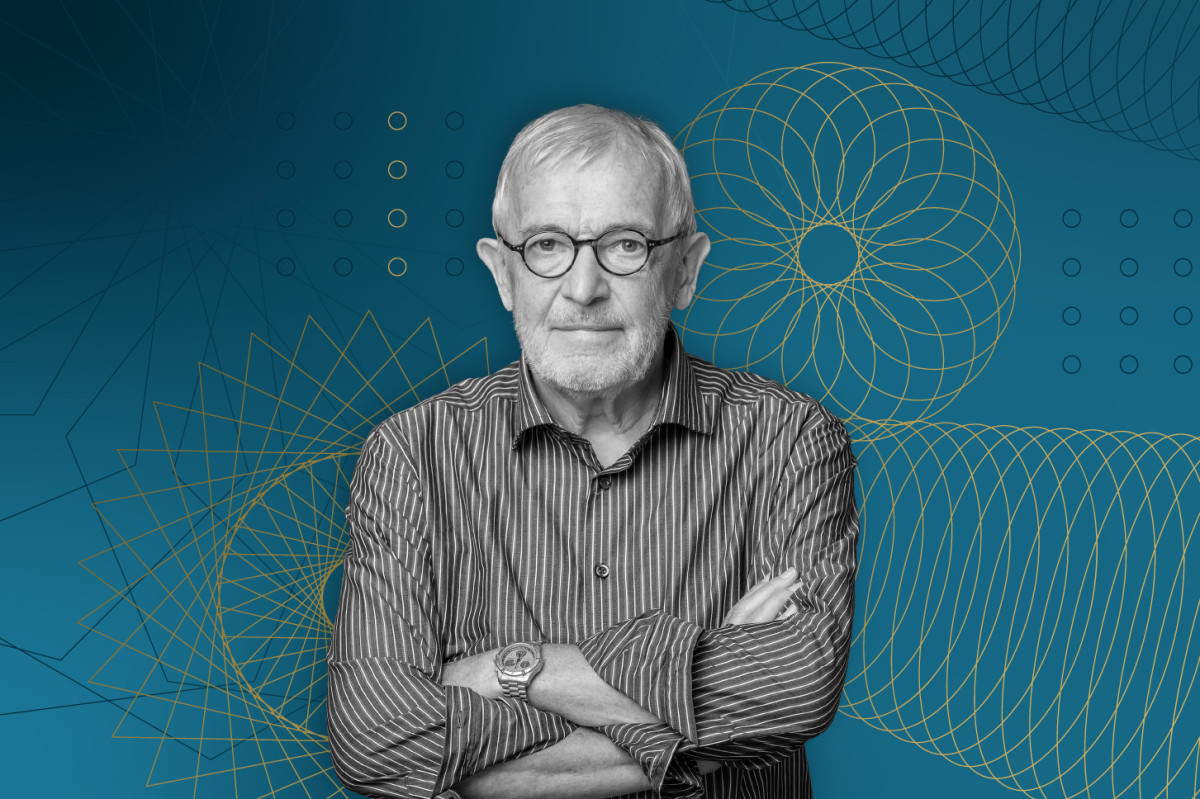
Today, Francis Halzen, a University of Wisconsin–Madison professor of physics, was named the recipient of the Nobel Prize in physics at the Royal Swedish Academy of Sciences in Stockholm, Sweden.
The prize was conferred for Halzen’s contributions to our understanding of the astrophysical particles known as neutrinos, produced by the universe’s most energetic events.
“This is a celebration of a very unusual project,” says Halzen. “It is difficult to imagine that we could have pulled this off anywhere but at UW–Madison with its unique research infrastructure. The success of this project involved some luck, and I was fortunate to be at UW, where unconventional ideas can thrive and where I had the support of a remarkable community, from talented engineers at the Physical Sciences Laboratory to long-time colleagues on the faculty and supportive administrators. It is hard to imagine this project happening anywhere else.”
Halzen is the principal investigator of the NSF IceCube Neutrino Observatory, the world’s largest — and perhaps strangest — telescope. The U.S. National Science Foundation-funded observatory is operated by an international collaboration of scientists led by the Wisconsin IceCube Particle Astrophysics Center based at UW–Madison.
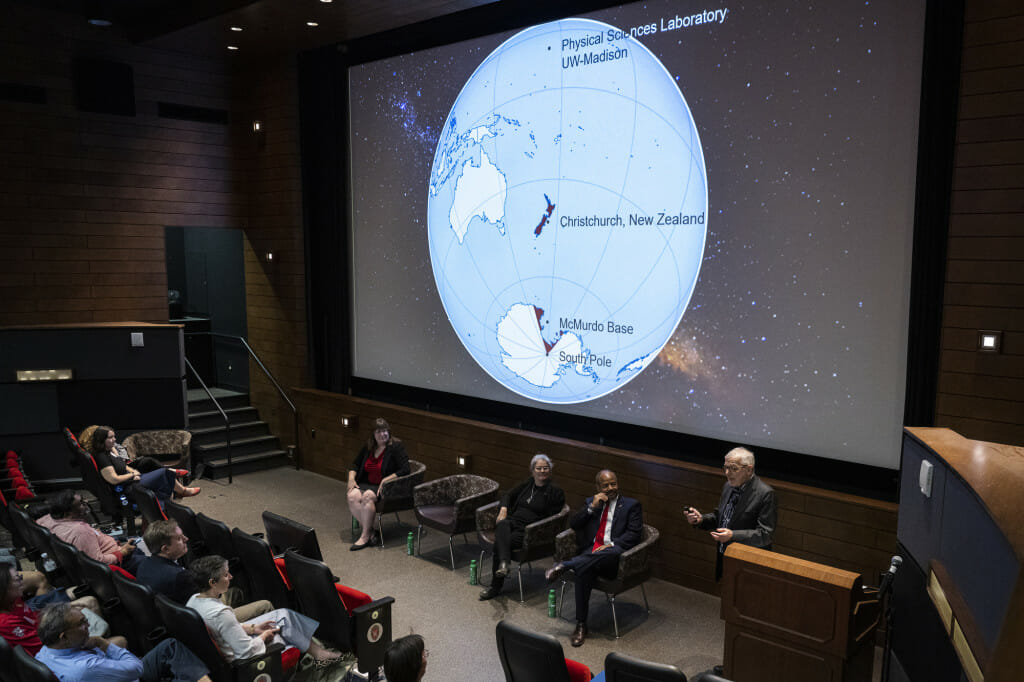
Embedded in a cubic kilometer of Antarctic ice, IceCube uses thousands of light sensors to survey the universe for neutrinos, nearly massless particles that rarely interact with other matter. Neutrinos provide information about the workings of black holes, galaxies and other objects in the cosmos.
“IceCube is like no other telescope in the world,” says UW–Madison interim Chancellor Eric M. Wilcots. “And there is no other scientist quite like Francis Halzen, whose idea to create a neutrino detector under almost a mile of ice has led to a remarkable multinational and multi-institutional scientific collaboration and a fundamental shift in how we think about the universe.”
Unlike the neutral neutrino, cosmic rays are charged particles whose paths cannot be traced directly back to their sources. But the powerful cosmic accelerators that produce them, like supermassive black holes, will also produce neutrinos. These so-called “ghost particles” travel nearly undisturbed from their accelerators, giving scientists an almost direct pointer to their source.
Along with observations by other telescopes, the neutrino first detected by IceCube provided the first-ever evidence of a source of high-energy cosmic rays, whose origins have been notoriously difficult to pinpoint since their discovery over 100 years ago by 1936 physics Nobel laureate Victor Hess.
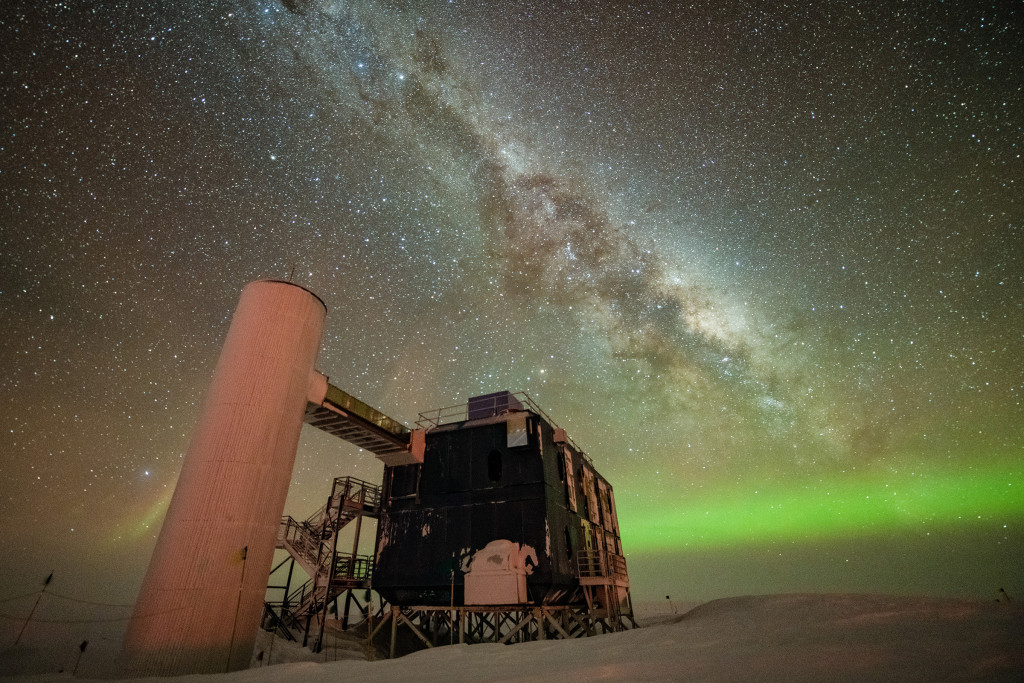
In 2013, IceCube announced the first detection of high-energy neutrinos from outside the solar system. The finding opened a new era of “multi-messenger astrophysics” in which not only light but particles like neutrinos and gravitational waves can provide us with information about distant cosmological events, like supermassive black holes located at the heart of galaxies. The discovery won the 2013 Physics World Breakthrough of the Year Award.
Four years later, in September 2017, IceCube detected a high-energy neutrino from a supermassive black hole at the center of a distant galaxy in the direction of the constellation Orion. More recently, IceCube provided the first evidence of high-energy neutrino emission from an active galaxy 47 million light-years away, in 2022, and from the Milky Way, in 2023. These detections demonstrated that all three of these sources produce cosmic rays. Most recently, IceCube was successfully upgraded, marking the observatory’s first significant expansion since its completion 15 years ago.
With this award, Halzen becomes the sixth physicist connected to UW–Madison to earn the Nobel Prize. It’s the 23rd Nobel Prize tied to UW–Madison overall, in a legacy that spans medicine, chemistry, economics, engineering and physics. The last active UW–Madison faculty member to win a Nobel Prize was Howard Temin in 1975, honored for his discovery of reverse transcriptase — a breakthrough that reshaped molecular biology and deepened understanding of diseases like Hepatitis B and HIV.