UW Regents meeting covers Mnookin farewell, AI efforts, pluralism, business partnerships
UW–Madison hosted the Board of Regents of the University of Wisconsin System, delivering an agenda packed with campus highlights and a range of speakers.
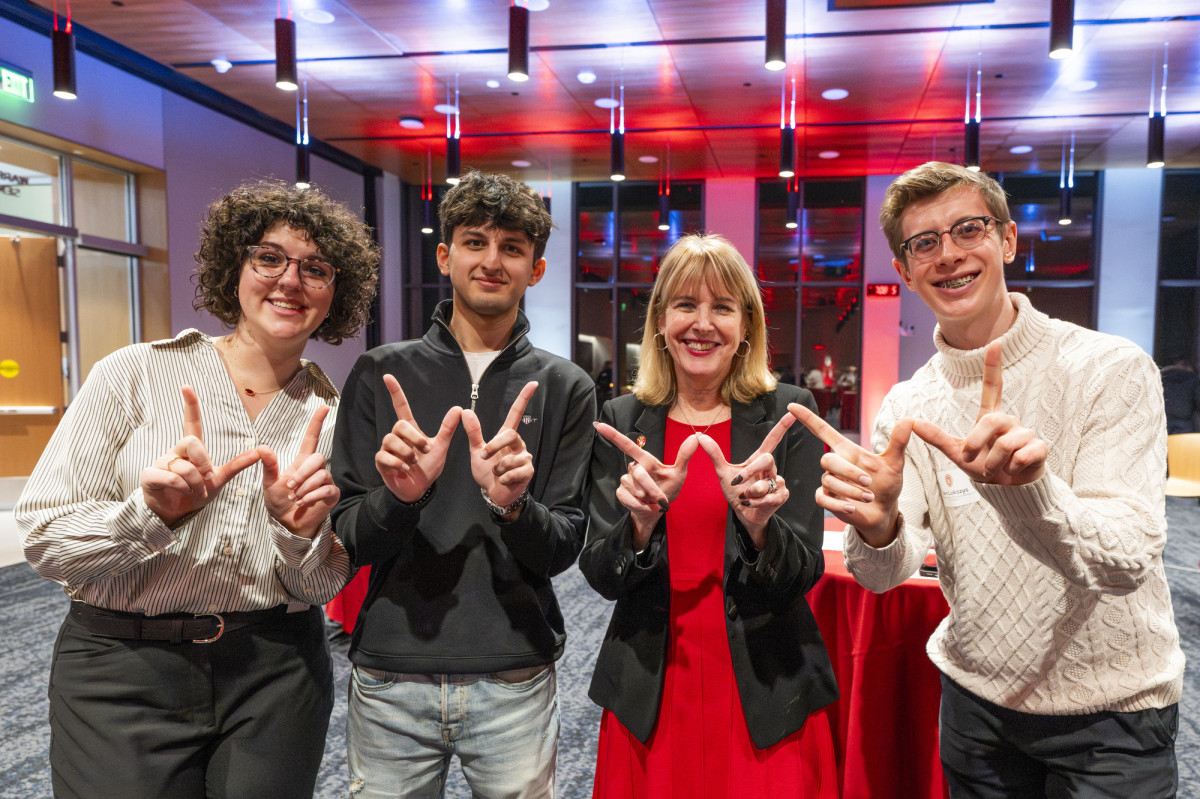
Every February, the University of Wisconsin–Madison hosts the University of Wisconsin System Board of Regents meeting, where, over two days, university leaders update the board on progress, points of pride and key initiatives through a series of panels, presentations and tours.
Below are selected highlights from the meeting, which took place Feb. 5 and 6.
Chancellor Mnookin delivers her final remarks
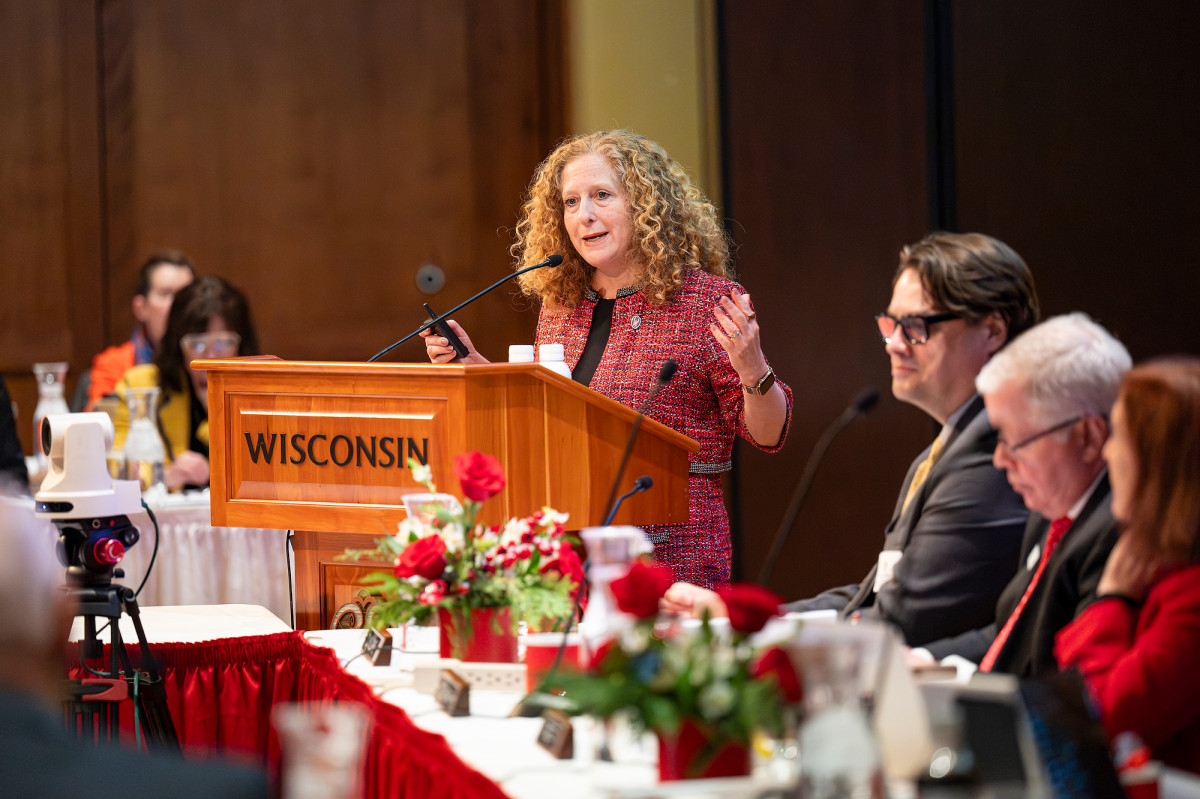
In her final address to the Regents, Chancellor Jennifer L. Mnookin reflected on the meaningful ways UW–Madison has maintained forward momentum despite challenges facing higher education, and outlined next steps that will enable the university to continue to thrive.
“UW–Madison is a center of gravity for the entire Universities of Wisconsin system and, indeed, the entire state,” she said. “I believe the strength of one rises or falls with the strength of the other.”
Mnookin expressed her gratitude to UW–Madison’s faculty, staff and students; fellow Universities of Wisconsin chancellors; the Board of Regents and System leadership, including President Jay Rothman.
AI panel discusses innovations in research, education and engagement
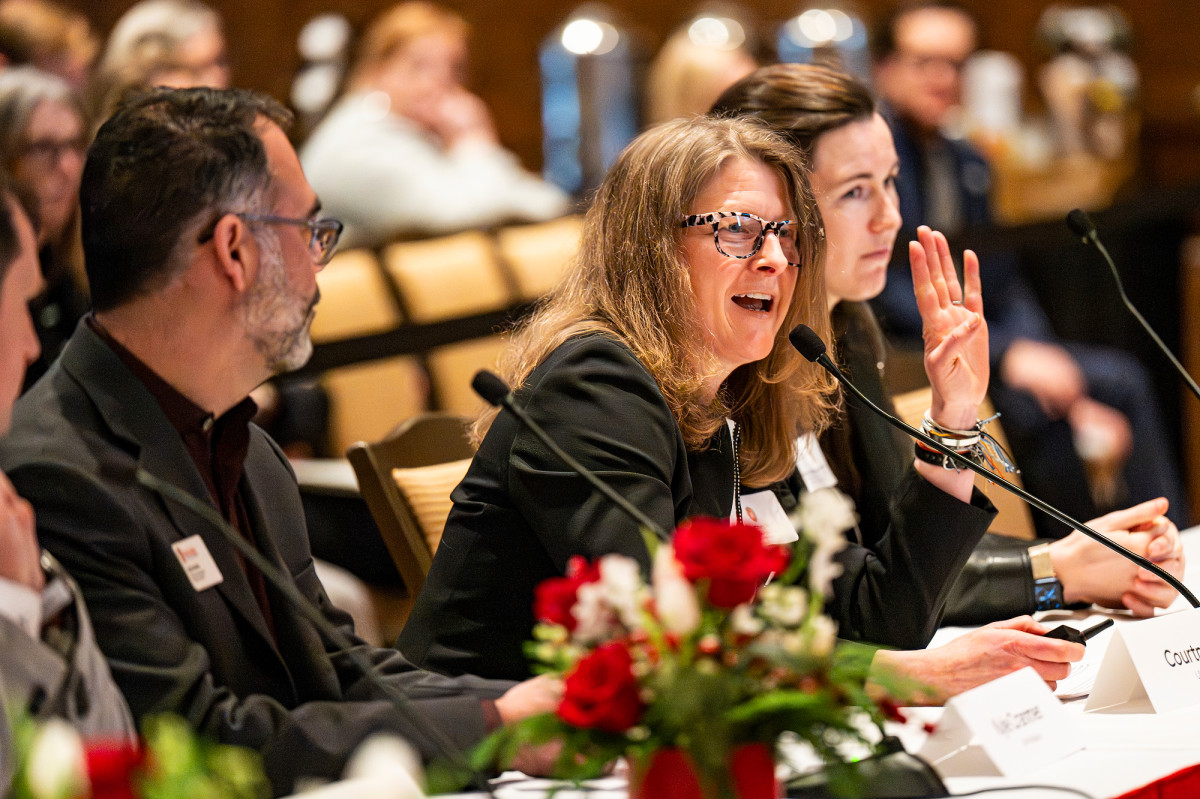
A panel of UW–Madison researchers were the lead-off to an afternoon presentation on how Universities of Wisconsin schools are on the leading edge of artificial intelligence innovation.
Kyle Cranmer, director of UW–Madison’s Data Science Institute, provided an overview of the AI-focused area of the Wisconsin Research, Innovation, and Scholarly Excellence initiative, or RISE-AI, that the university launched in early 2024.
The “North Star” guiding the initiative is for UW–Madison to serve as a trusted partner, for Wisconsin and the nation, in navigating the opportunities and complex issues that AI raises. More than 50 new faculty have been hired through the initiative, representing the breadth of the university and integrating with existing faculty pursuing the study of AI.
Cranmer said researchers approach AI from three complementary perspectives: What is the underlying technology, what opportunities does it present, and what are the actual impacts of the technology?
As an example, he cited the use of ambient AI in health care, in which AI “scribes” listen to and summarize conversations between a patient and medical practitioner, allowing the practitioner to focus more on the patient. In a randomized clinical trial, UW researchers investigated the impact of the technology on health care providers.
“What they found is actually somewhat surprising,” Cranmer said. “The doctors found the time (they spent with patients) was more thoughtful and the technology actually reduces burnout.”
The work of RISE-AI is organized around three main pillars: research, education and engagement.
Highlighting the research pillar, Hannah Wayment-Steele, professor of biochemistry in the College of Agricultural and Life Sciences, spoke about using AI to study the dynamic movements of proteins, which could have implications for drug discovery and more.
Jeremy Morris, professor of media and cultural studies in the Department of Communication Arts whose research focuses on the social and cultural effects of AI, spoke about the education pillar. UW–Madison received a $720,000 grant from the National Endowment for the Humanities to launch the Center for Humanistic Inquiry into AI and Uncertainty, which is serving as a hub for collaboration across several schools and colleges.
Speaking to the engagement pillar, Courtney Bell, professor of education psychology in the School of Education, illustrated how she is using AI in teaching, workforce development and research. Her work focuses on how to balance AI’s capabilities with its constraints to enhance innovative teaching and learning while remaining focused on ensuring students have access to a high-quality education.
Wisconsin Exchange seeks to foster dialogue across difference
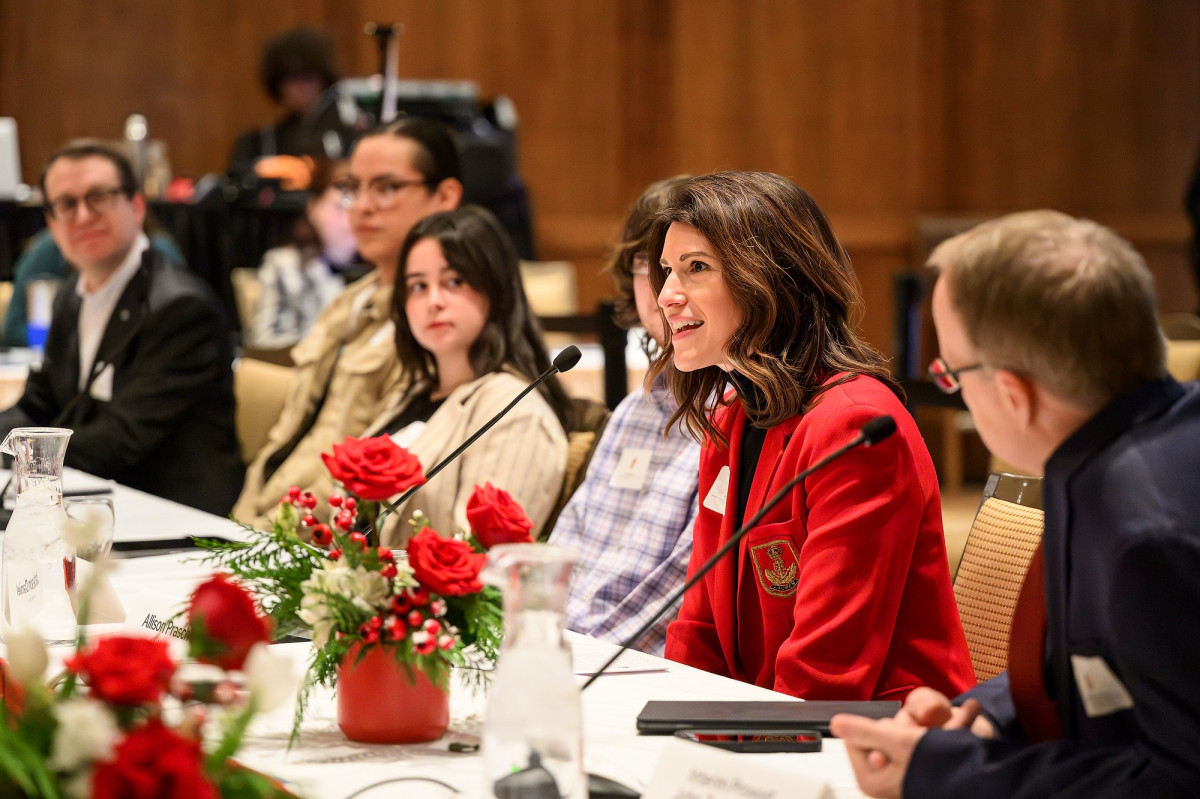
A panel of faculty and students shared with the Regents UW–Madison’s new effort focused on creating an environment where people with different points of view across campus engage with each other in constructive and respectful ways.
The Wisconsin Exchange is rooted in the notion that pluralism, rigorous intellectual engagement and the exchange of ideas has been a core value of this university for generations, Mnookin said.
She said the Exchange is a way to create thoughtfully designed opportunities for interaction and engagement with diverse points of view in myriad ways, which is essential, for instance, to preparing students for citizenship in our democracy.
Mnookin said the initiative is “the result of a collective effort reflecting the wisdom of students, faculty and staff.”
The panel, led by interim Provost and Chief Academic Officer John Zumbrunnen, included:
- Professor of Rhetoric, Politics and Culture Allison Prasch, Wisconsin Exchange steering committee member
- Professor of Political Science and Director of the Tommy G. Thompson Center on Public Leadership Alex Tahk, Wisconsin Exchange steering committee member
- Miranda Garcia-Dove, student majoring in information science and political science with a certificate in public policy
- Shane Funmaker, student majoring in social welfare with certificates in public policy, political economy, philosophy and politics
- Jackson Daniel, student majoring in computer sciences with a certificate in mathematics.
Daniel was a part of the first cohort to participate in Deliberation Dinners, a program that provides UW–Madison undergraduate students an opportunity to engage in a setting that exposes them to multiple perspectives and competing ideas. He said the point is to get students together to talk about difficult topics, “not to get consensus, but understand each other better.”
Embracing a diversity of viewpoints is essential to the mission of the university, Tahk said.
“The fundamental mission of a university is the search for truth, and you can’t do that without engaging with all views,” he said. “It goes to the core of the Wisconsin Idea. We can’t be effective … if we are not open to the views of the entire state.”
Prasch said she develops courses that intentionally engage multiple viewpoints for students.
“We see students who desperately want to know how to sift and winnow, and they want to do it together,” she said.
The university has launched a grant program within the Wisconsin Exchange to help turn outstanding engagement ideas into action; this week, 10 projects with transformative potential were named.
Regents give Business Partnership Award
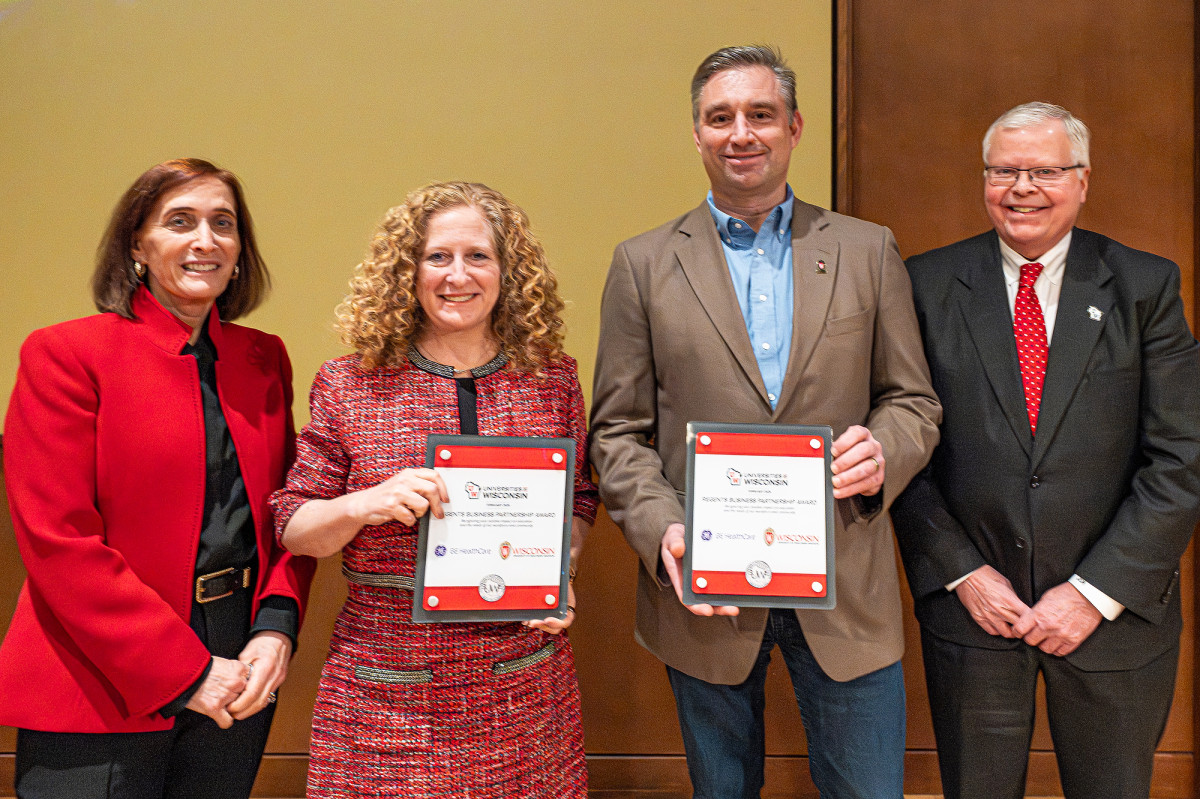
On Thursday, the Board of Regents recognized the long-running research collaboration between the University of Wisconsin–Madison and GE HealthCare with the Regents Business Partnership Award.
UW–Madison and GE HealthCare have completed more than 130 research projects together, leading to numerous scientific and technological advancements. The partnership has generated nearly 100 patents to date.
The award celebrates the mutually beneficial partnerships between the Universities of Wisconsin and Wisconsin’s business community that have a positive impact across the state.