How UW–Madison and industry are working together to shape Wisconsin’s AI future
As businesses explore how to apply AI effectively and responsibly, UW researchers, faculty and students are offering their knowledge in the emerging space.

Artificial intelligence has transformed from science fiction to a part of daily life. It is aiding in online searches, summarizing email inboxes, writing code, guiding robots in factories, assisting with diagnoses in hospitals and shaping conversations in nearly every boardroom. The technology arrived quickly, and public perception is still taking shape.
For many organizations, the question is no longer whether AI will matter, but how to apply it effectively and responsibly. Increasingly, they are turning to experts at UW–Madison for guidance.
That expertise spans the university. Faculty and researchers across schools and colleges are approaching AI from different angles, from business and engineering to health care and public systems. The University’s AI Hub for Business, for example, includes 23 CEOs, vice presidents and directors from Fortune 500 companies such as Google, Walmart, Reddit, Medtronic, Kimberly-Clark, Bain and Accenture. The School of Computer, Data & Information Sciences (CDIS) is also meeting the moment and evolving into the College of Computing & Artificial Intelligence, reflecting the growing importance of this field.
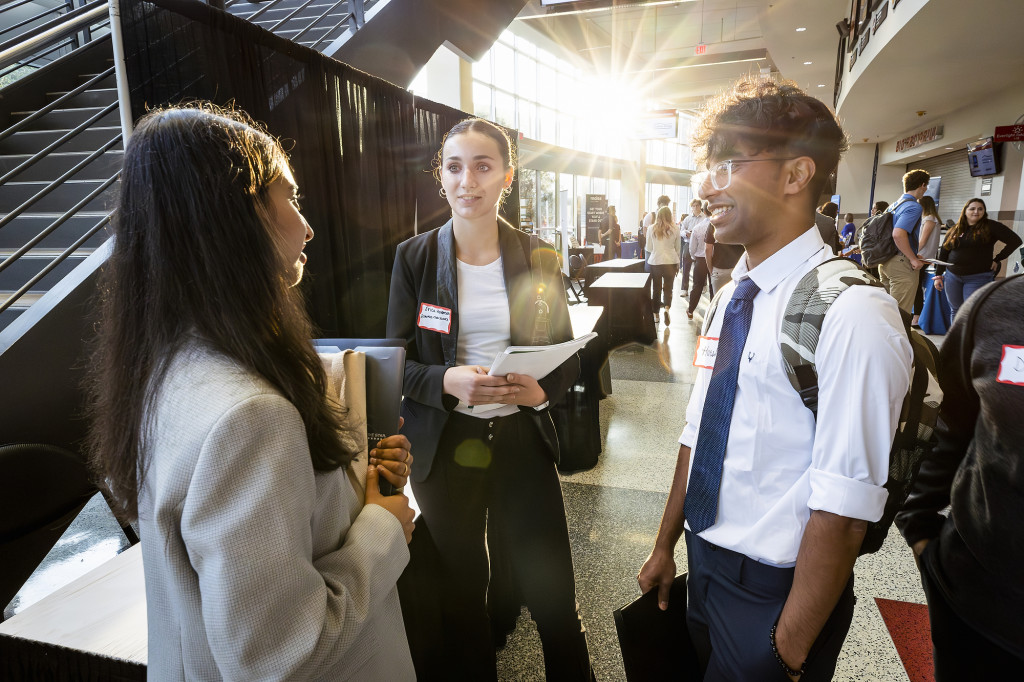
On any given day, UW–Madison students are working directly with Wisconsin companies to explore how artificial intelligence can solve real-world problems. They refine tools for major health care systems, streamline aerospace supply chains, and build the AI literacy skills employers increasingly expect.
To better understand how these partnerships are taking shape across campus, we spoke with UW–Madison leaders working at the intersection of research, teaching, and business engagement.
Learning By Doing: Where Students and Industry Meet
Justin Hines — Director of Corporate Relations, CDIS

Q: How does CDIS support collaboration between industry and campus around AI, particularly through teaching, research, and applied projects?
A: Many organizations, startups to large corporations, are still determining where and how AI will create value within their operations. Capstone teams allow companies to explore these questions in a low-risk, high-impact environment. Students help vet ideas, find solutions, and identify technical challenges early, de-risking AI adoption before production or broader implementation. This model benefits both students and partners by aligning academic learning with real business needs.
Q: What kinds of AI-related questions or challenges are companies most interested in exploring with UW–Madison right now?
A: Most companies are focused on practical, short-term questions and how existing AI tools can be integrated into their organizations to deliver measurable impact. Organizations are way more interested in asking how AI fits into their specific industry, culture, and operational constraints.
Matt Seitz — Executive Director, AI Hub for Business

Q: From your perspective, how are industry partners thinking about AI right now, and what kinds of applications or capabilities are they most eager to explore or adopt?
A: Most business leaders I talk with have gotten off the sidelines and are now taking action on AI. The theory is interesting, but they are looking for practical ways AI can drive value in their enterprises. Many are starting with customer chatbots and process automation for efficiency, while the most advanced are using AI to build software and capture strategic growth. Early movers are building real competitive advantages. In April, we’re hosting an AI for business “Ground Truth” summit to help leaders move from theory to action.
Q: What’s one skill or mindset around AI you hope UW students develop now that will matter most as they graduate?
A: The leaders of the future won’t be the ones who use AI the most but the most effectively. Students need to develop judgment about where AI adds value and where human oversight is essential. For example, a student might use AI to draft a competitive analysis and get a polished, confident result with completely fabricated market sizing data. The skill isn’t generating output; it’s knowing when and how to verify it before it lands on a VP’s desk. That means understanding the technology well enough to ask the right questions, spot limitations, and make informed decisions about how to use and deploy AI in their organizations.
Q: If you fast-forward five or ten years, what’s one way AI could change how people in Wisconsin work or do business that might surprise them today?
A: In five years, AI will be embedded in every job the way today’s workers use Excel or Google. Tasks that used to take days, like building a financial model, market analysis, or competitive landscape, take hours with AI support. And it’s not just knowledge work. Plant managers will use AI to predict equipment failures, sales teams will walk into meetings with AI-generated insights, and supply chain leaders will be able to reroute logistics in real time. The value of human workers will shift toward judgment, creativity, and relationship-building. Businesses that invest in building human-plus-AI capabilities today will be able to compete with organizations twice their size.
Translating Real-world Problems Into AI Solutions
Kyle Cranmer — Director, UW–Madison Data Science Institute

Q: What kinds of industry-driven questions or challenges are you seeing most often right now in AI and data science?
A: It varies widely, but a common theme is how to integrate AI and data science deeply into business processes. That includes incorporating large language models and agentic AI approaches and rethinking how data is managed and governed to fully take advantage of recent advances.
Closely related is the challenge of trustworthiness—addressing hallucinations, maintaining privacy and confidentiality, and responsibly handling sensitive information.
Q: How does the Data Science Institute help connect AI research, teaching, and real-world problem solving across UW–Madison, especially when working with industry partners?
A: Most real-world problems require a period of translation before an AI approach can be brought to bear. The Data Science Institute brings together affiliated faculty with deep domain expertise and experience with translation. That allows us to engage the right AI researchers across campus, whether the problems originate in academic research or from industry partners.
Q: How does AI accelerate discovery in areas that are important to Wisconsinites or Wisconsin industry?
A: AI is dramatically accelerating the pace of discovery, especially in areas like drug discovery. AI is guiding the search for new materials that have unique properties, such as the ability to sequester C02 from the atmosphere. These candidate drugs and materials still need validation through traditional experimental methods, but AI is transforming the front end of the discovery process.
John Garnetti — Managing Director, Office of Business Engagement

Q: Why are companies choosing to work with UW–Madison on AI instead of trying to figure it out on their own?
A: I think both are true. There are areas of research related to AI where we excel—and that’s true of universities more broadly—and there are other, often complementary areas of research where industry excels. It’s through sustained collaboration that we can best leverage our respective strengths to do more together than we can apart. But to answer your question directly, companies choose to partner with UW–Madison in particular because we have deep expertise in AI and data science, AND we have incredible breadth as an institution. Very few universities have world-class researchers in medicine, education, engineering, agriculture, and business. To sum it up more succinctly, the nature of most private sector work is cross-functional, and the strong interdisciplinary research environment at UW–Madison mirrors that.
Q: How do these AI partnerships support Wisconsin’s economic development and workforce goals?
A: I think these partnerships and their outcomes are absolutely critical to the state’s economic development and workforce goals. I agree with the sentiment that AI is a transformational technology on par with the Internet, and few, if any, aspects of our society will be unaffected by it. As the state’s flagship university, I feel there is much we can do to help our state lead in this space through partnership with not just industry, but with government and community organizations and our peer higher educational institutions who are doing fantastic work in this space, as well.