Robert George, Cornel West: Truth-seeking starts with admitting you might be wrong
Visiting UW–Madison, the two scholars and close friends from opposite ends of the political spectrum make the case for talking it out.
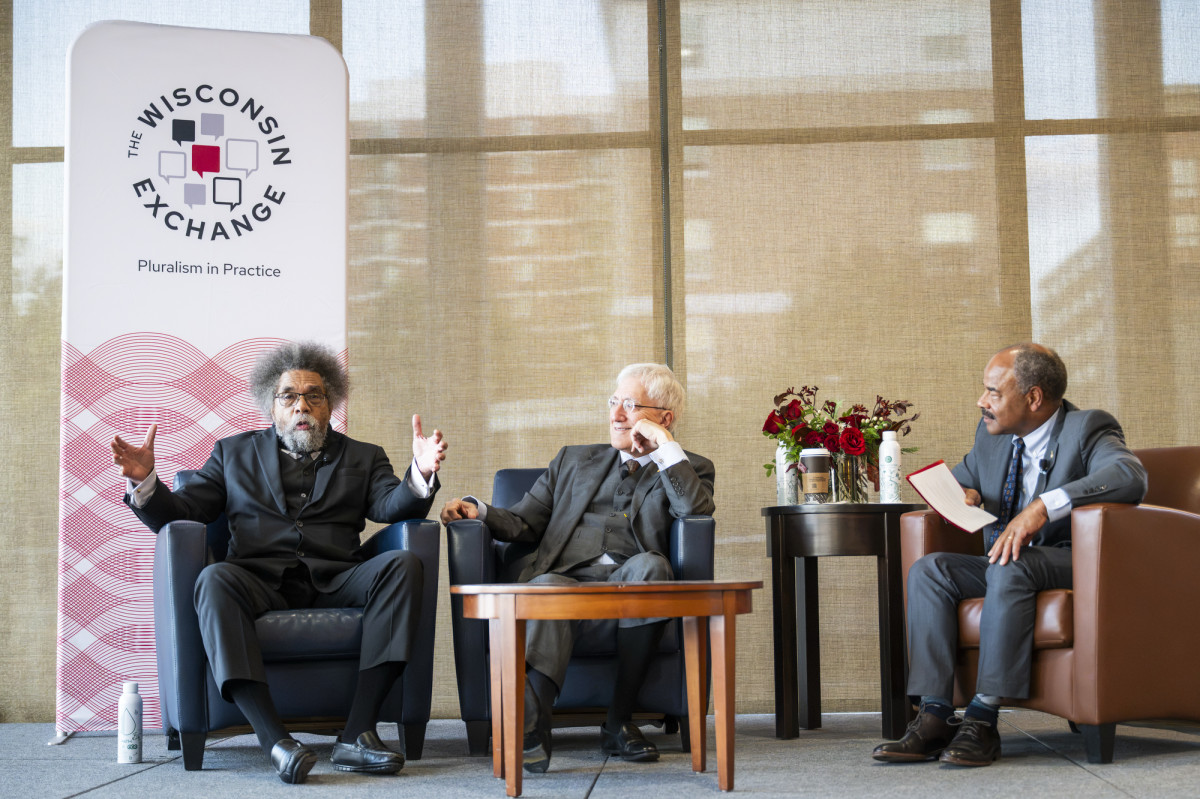
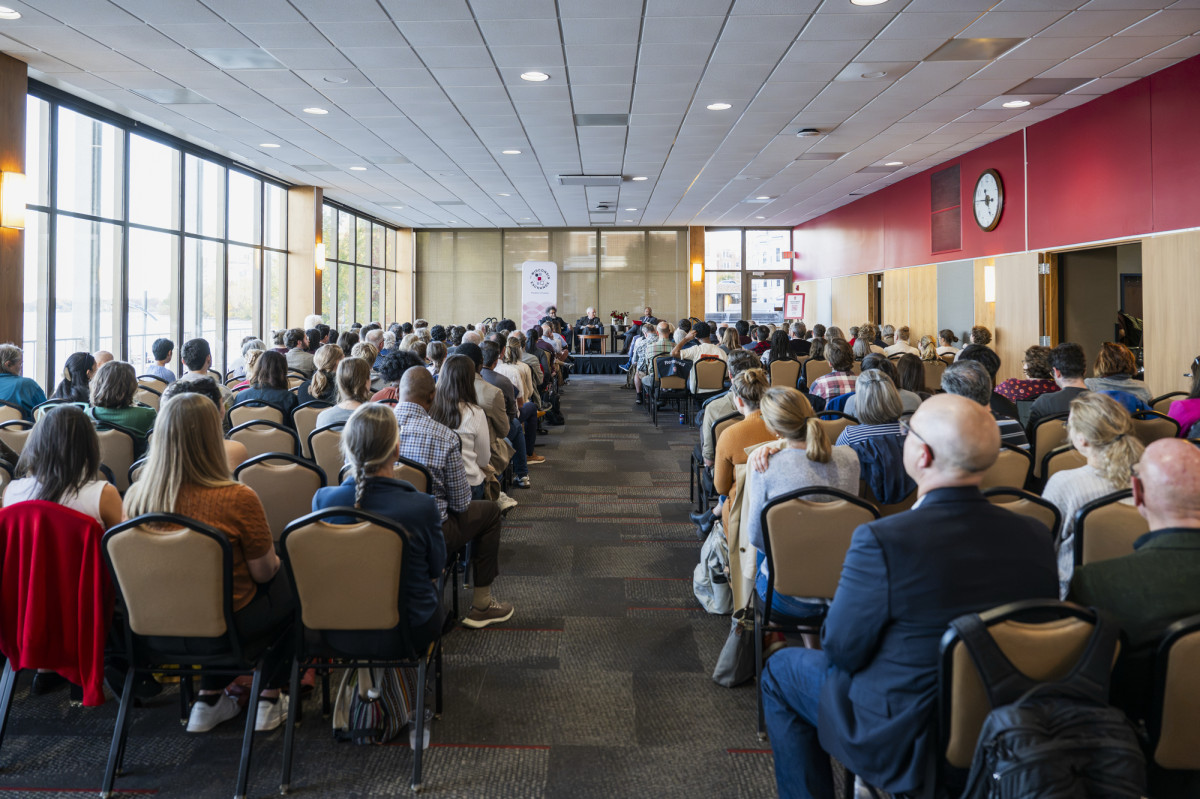
With a polarized midterm election less than a week away, Robert P. George and Cornel West made the case for practicing intellectual humility both within and outside the classroom to a packed room Wednesday at the University of Wisconsin–Madison’s Pyle Center.
The event was part of the Wisconsin Exchange, launched about a year ago to promote open inquiry and constructive dialogue on campus. Its initiatives include a grant program, a Pluralism Postdoctoral Fellowship that brought seven fellows to campus this fall, and an annual Pluralism in Practice Workshop.
“Which of you out there right now has only true beliefs in your head and no false beliefs?” George, a conservative legal scholar at Princeton University, asked the audience of more than 200 students, faculty and community members.
With no one raising a hand, George continued.
“I know some of my beliefs are wrong, but I don’t know which ones they are,” he said. “We’re all in that same position.”
George and his longtime intellectual sparring partner West, a well-known progressive and public intellectual, argued that students and professors shouldn’t shy away from this shared fallibility. Instead, the pair said, they should recognize it as a starting point for conversations across deep — and even seemingly insurmountable — differences.
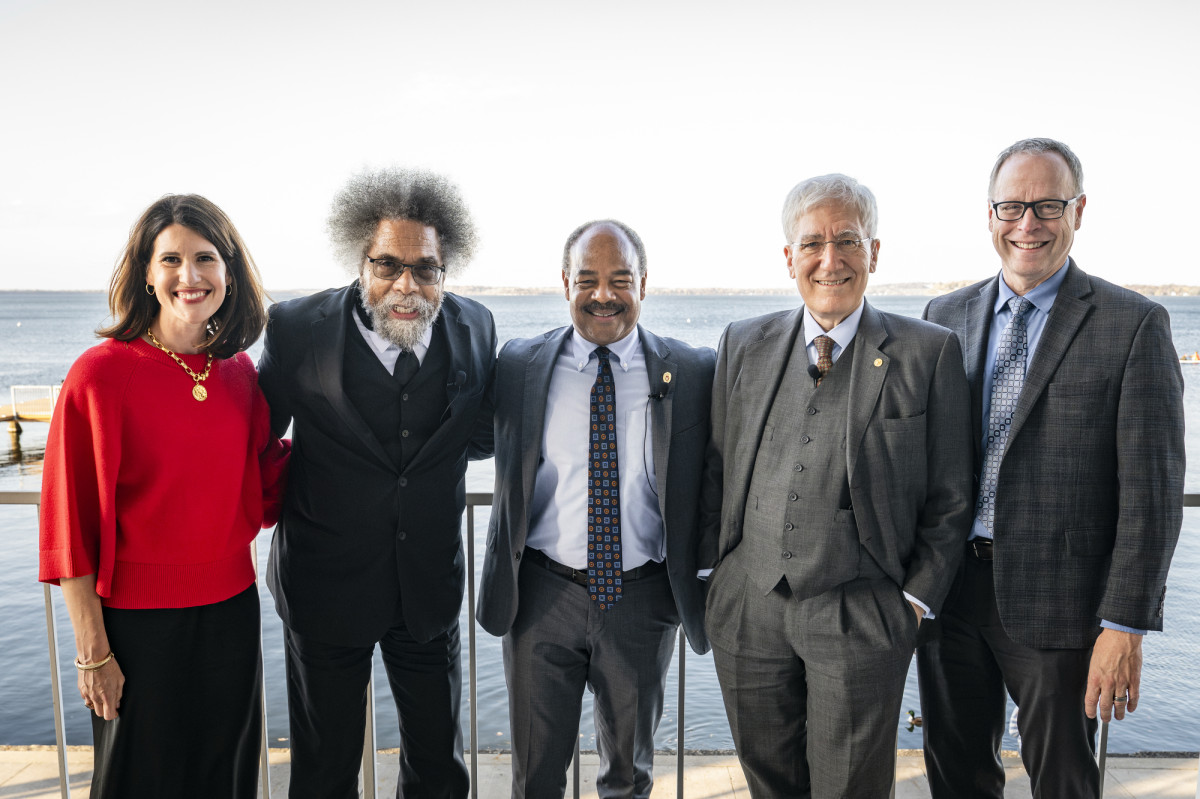
The conversation, “Constructive Dialogue in a Divided Age: What Universities Can Teach About Listening, Learning, and Truth,” was moderated by interim Chancellor Eric Wilcots. The event drew on themes from George and West’s 2025 book, “Truth Matters: A Dialogue on Fruitful Disagreement in an Age of Division,” a series of conversations exploring how people with deeply different convictions can engage one another respectfully while pursuing truth and the common good.
Noting UW–Madison’s location in a politically divided state, Wilcots also tied the conversation to the university’s tradition of “sifting and winnowing,” the principle of free inquiry memorialized on a plaque at Bascom Hall.
UW–Madison is well situated to show what it looks like to engage with curiosity and humility and respect for each other’s humanity, even when we do disagree.
UW–Madison is “well situated to show what it looks like to engage with curiosity and humility and respect for each other’s humanity, even when we do disagree,” Wilcots said.
Indeed, George and West contended that the ability to respectfully engage across difference is a skill every bit as valuable as any other. And it’s one that UW–Madison and other institutions of higher education should help students develop.
The two have plenty of practice. George, the McCormick Professor of Jurisprudence and director of the James Madison Program in American Ideals and Institutions at Princeton, and West, the Dietrich Bonhoeffer Professor of Philosophy and Christian Practice at Union Theological Seminary, have co-taught a course for nearly two decades that challenges students to interrogate their own beliefs while debating each other with honesty and respect.
The course provides a setting that may unsettle students, something that both speakers argued a genuine liberal arts education should do.
“It’s not a safe space; it’s a space [where] you’ll be respected,” West said. “We hope for at least a moment you recognize that your worldview rests on pudding.”
Intellectual growth, West added, requires letting go of assumptions “as a form of death in order to be reborn.”
In their classroom, George said, no position is off limits, but every position argued must also be defended.
“The currency of proper intellectual discourse consists of reasons, evidence and arguments,” he said. “We don’t want to hear your epithets.”
Responding to an audience question about how to handle interactions that may involve hurtful or offensive perspectives, West recalled participating in a counterprotest in Charlottesville, Virginia, where he said he faced armed white supremacists and racial slurs. The key, he said, is resisting the urge to respond from the gut, while still holding people responsible for what they say and do.
George also pushed back on the idea that civil discourse simply means listening politely while privately thinking, “What an idiot.”
“Civil discourse is where the interlocutors engage each other in a spirit of humility and … truth-seeking,” he said.
Watch a recording of the talk.