
Through top scholarship, Navy sailor is docking at UW for a bachelor’s degree
Freshman Lorelai Haase will maintain her active-duty status while pursuing a bachelor’s degree in nuclear engineering.
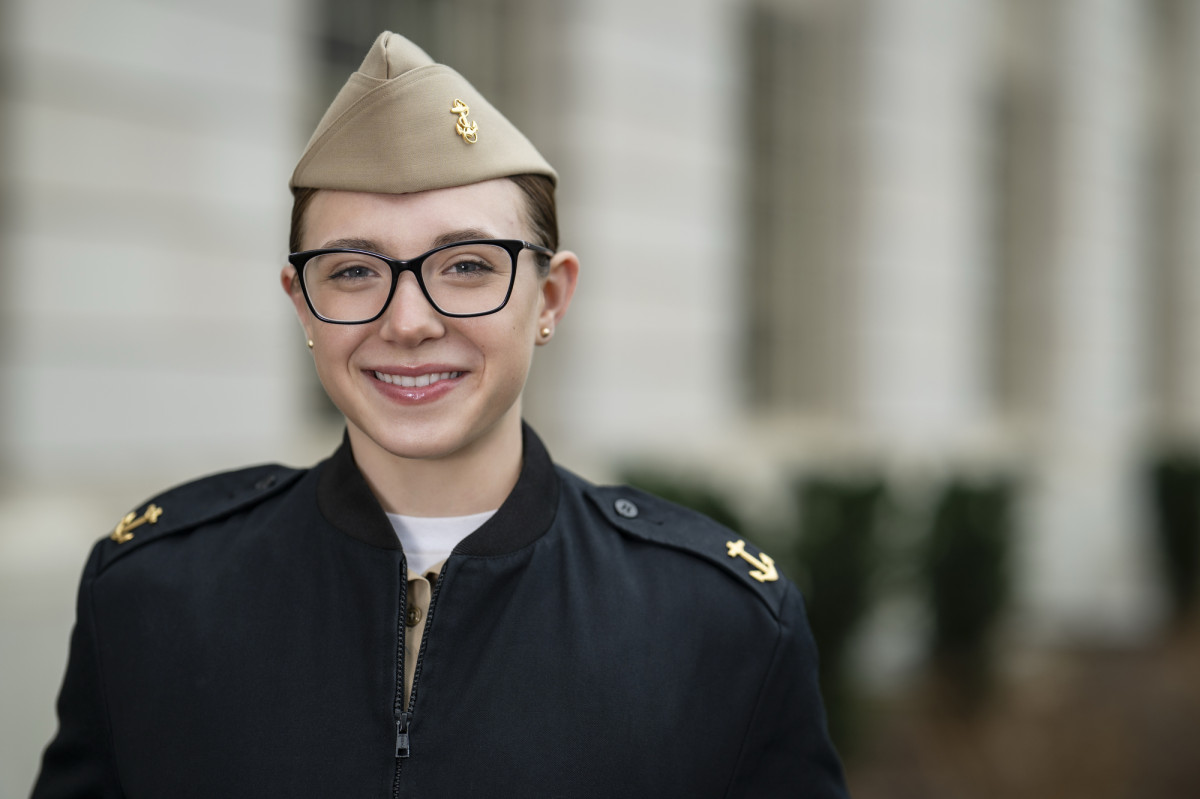
Some college-bound students prioritize a university’s location or campus culture when choosing where to apply. Lorelai Haase had something else in mind: Her dream school needed to have a nuclear reactor.
Haase, an active-duty sailor in the U.S. Navy, works on nuclear reactors aboard aircraft carriers and submarines as a machinist in the Naval Nuclear Propulsion Program. She’s also a freshman at the University of Wisconsin–Madison, majoring in nuclear engineering. (And yes, UW–Madison has a nuclear reactor on campus for teaching and research.)
Haase, of Oostburg, Wisconsin, is attending college through the Seaman to Admiral Program. The scholarship program provides highly qualified enlisted sailors the opportunity to earn a commission as a naval officer while pursuing a degree at a top-tier university.
Haase will be the only student at UW–Madison this academic year on the scholarship, according to Capt. John Barnett, who heads the Navy ROTC program at UW–Madison. Two students in the program graduated this past May.
“It’s a highly competitive program,” Barnett says. “The scholarship recipients we get at UW through this program are typically outstanding sailors and students.”
Haase will maintain her active-duty status while pursuing a bachelor’s degree in nuclear engineering, a major that combines her interest in math and problem solving.
“Nuclear power is largely a safe and a secure alternative to fossil fuels,” she says. “I’d love to be a part of building that future as an engineer.”
At UW–Madison, Haase will join about 600 other students who are either military veterans or currently enrolled service members, says Joe Rasmussen, director of University Veteran Services. The number of military-connected students — a category that includes children of active service members or veterans — is estimated to be around 2,000, out of a total student body of about 52,000.
Haase has wanted to be a commissioned military officer since eighth grade, when she joined a nearby division of the Naval Sea Cadets Corps, a youth leadership organization sponsored by the U.S. Navy. The allure of the Navy is multifold, she says. Three uncles are Navy veterans, and she grew up near the shores of Lake Michigan, loving to swim. She likes the discipline required of a military life, and she welcomes the opportunity to serve her country and others.
Throughout high school, Sea Cadets pushed her physically and mentally, she says, helping her develop strong study habits, a diligent work ethic, and leadership skills. Memorable experiences during that time include a two-week training course at the Great Lakes Recruit Training Command in suburban Chicago at age 13 and an advanced scuba training course in Maine.
Haase enlisted in the Navy immediately after graduating from Oostburg High School in 2023. At both boot camp and technical training school, she rose to leadership positions in her units.
Boot camp was hard but probably a good precursor to some of the rigors of college, she says.
“You’re forced to find and build a new support system with people who are essentially strangers,” she says. “You learn how to work as a team in 10 short weeks and push yourself beyond what you thought you were capable of. You’re tired all the time, yet you persevere and power through.”
Haase is no stranger to long-term goals. She’s a triathlete and competed nationally in high school in endurance horse riding. As required by the Navy scholarship program, she will be completing her bachelor’s degree in a condensed three years. She began taking classes this past summer, living in an apartment near campus with a big banner in one room that reads, “Don’t Give Up The Ship.”
While on campus, she’ll participate in Navy ROTC classes and activities, including 6 a.m. physical training twice a week. When she graduates in May 2028, she will have the rank of Ensign 0-1, the first step for those who graduate from officer training programs.
“Enlisting in the Navy after high school, I’ve faced challenges,” Haase says, “but I’ve also had a lot of amazing opportunities by taking this path.”