
Campus news Latest News
Curiosities: What’s the difference between an economic recession and a depression?
The “official” arbiter of recessions is the National Bureau of Economic Research (NBER), a private, nonprofit research organization, comprising a number of top economists,…
Clean air action day announced for Feb. 9
As Dane County gears up for a Clean Air Action Day on Monday, Feb 9, UW–Madison is taking an active role to help safeguard local air quality.

Mathematical models reveal how organisms transcend the sum of their genes
Molecular and cellular biologists have made tremendous scientific advances by dissecting apart the functions of individual genes, proteins, and pathways. Researchers at the University of Wisconsin–Madison College of Engineering are looking to expand that understanding by putting the pieces back together, mathematically.
UW-Madison: Russell Athletic relationship will end
The University of Wisconsin–Madison will end its business relationship with Russell Athletic at the expiration of its current licensing agreement in March.
UW-Madison to host bash for Darwin’s 200th birthday
Feb. 12 marks the 200th birthday of Charles Darwin, the founding father of evolution, and scientists, historians and other Wisconsin scholars are planning a daylong celebration in honor of the British biologist and his legacy.
Paper industry executive to lead Wisconsin Bioenergy Initiative
Troy Runge, research director at Kimberly-Clark Corp., has been named director of the Wisconsin Bioenergy Initiative (WBI).
Third annual 100-Hour Challenge stimulates student entrepreneurship
In the past, enterprising University of Wisconsin–Madison students have repurposed surplus materials to construct, among other things, a space heater safety alarm, a home reservoir system, a hand-cranking portable power generator and an artistic, wall-mounted light fixture.
Alternative Breaks deadline approaching
The deadline to apply to participate in UW–Madison's Alternative Breaks program is coming up.
Reason or faith? Darwin expert reflects
This is going to be a big year for evolutionary biologist Charles Darwin: 2009 marks the 150th anniversary of the publication of his book “On the Origin of Species,” and Feb. 12 would be his 200th birthday. Throughout the year, Darwin Day events are planned around the world to celebrate the man and his work, and to explore Darwin’s legacy of science and reason. On the top of many Darwin Day speakers lists is Ronald Numbers, Hilldale Professor of the History of Science and Medicine.
The Wisconsin Experience: Delta Program makes big impact on UW teaching culture
Teachers teach, students learn and researchers study. But the Delta Program in Research, Teaching and Learning turns teachers into students, students into teachers and both into researchers.

Genetic change prevents cell death in mouse model of Parkinson’s disease
By shifting a normal protective mechanism into overdrive, a University of Wisconsin–Madison scientist has completely shielded mice from a toxic chemical that would otherwise cause Parkinson's disease.
Free cake to celebrate UW–Madison’s 160th birthday
This year, the Wisconsin Alumni Association (WAA) is feeding students' minds as well as their bodies during the University of Wisconsin–Madison's birthday celebration.
WID plans town-hall meetings
The Wisconsin Institute for Discovery (WID) is sponsoring two additional open or town-hall meetings for interested faculty. The first is at 3 p.m. on Monday, Feb. 9. The topic of that meeting will be “Education and Outreach in WID.”
17th century science, music coincide in multimedia performance
The coincidental revolutions in music and science in the 17th century are the focal points of a free public multimedia event featuring Dava Sobel, author of “Galileo’s Daughter” and “Longitude,” and soprano Sarah Pillow and her Baroque ensemble, Galileo’s Daughters.
Campus celebrates Black History Month
Events ranging from lectures to performances have been scheduled on or near the University of Wisconsin–Madison in February in celebration of Black History Month.
Encouraging entrepreneurs: Undergraduate invention competition turns 15
In 1995, the University of Wisconsin–Madison College of Engineering debuted the Schoofs Prize for Creativity, a competition that provides university undergraduates the tools and resources to develop an original, patentable invention or process.
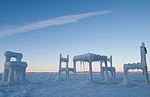
Recent sightings: Table for four
The winter sun sets behind “Ice & Snow Furniture Raised From Lake Mendota,” an art project by art student Hongtao Zhou. Zhou created the…

Single gene lets bacteria jump from host to host
All life - plants, animals, people - depends on peaceful coexistence with a swarm of microbial life that performs vital services from helping to convert food to energy to protection from disease.

Vet Medicine launches a new approach to E. coli food safety
Infection by Eschericia.coli O157:H7 from undercooked cattle meat proves deadly to about 60 people in the U.S. each year. While testing is available to detect the presence of the bacterium in raw meat, researchers at the University of Wisconsin–Madison would prefer to address the problem before the meat is sent to market.
University transforms warehouse into new, up-to-date Art Lofts
The tower of bright red steel girders signals that the old university warehouse at the edge of campus has been transformed. Facing the Kohl Center across Frances Street, the tower marks the main entrance to the Art Lofts, the new state-of-the-art facility for the Art Department.