Congrats to UW–Madison’s newest Nobel laureate: Francis Halzen
A message from interim Chancellor Eric M. Wilcots.
Dear campus community,
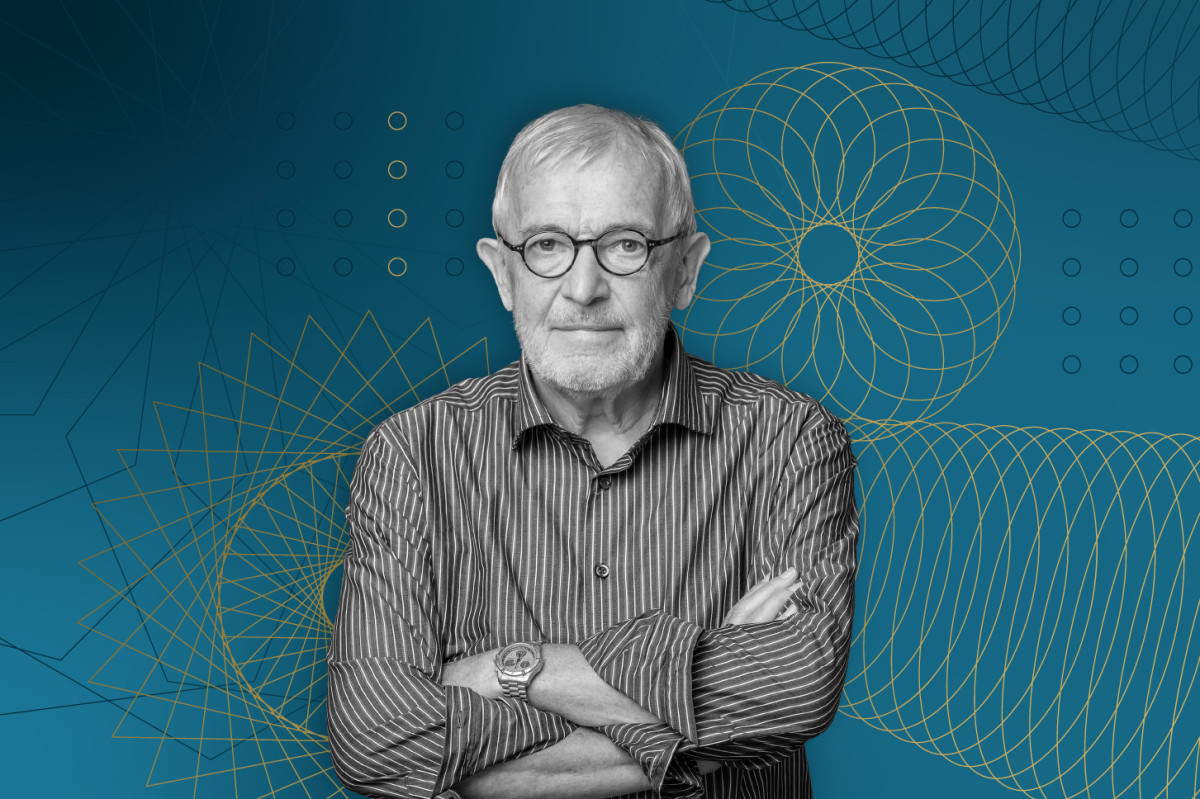
I could not be more thrilled today to share extraordinary news: Francis Halzen, professor of physics at the University of Wisconsin–Madison, has been awarded the 2026 Nobel Prize in physics for his pioneering contributions to our understanding of neutrinos, the elusive particles produced by some of the most energetic events in the universe.
This is a historic moment for Professor Halzen, for the field of physics and for our university. It is also a powerful reminder of something fundamental to who we are. UW–Madison is, like other universities of our kind, a place where transformative discoveries don’t necessarily begin with a business plan or a product roadmap.
Here, discoveries begin with a question. And today’s achievement reminds us that some of humanity’s greatest advances emerge from researchers pursuing difficult questions, simply because they are worth asking.
At UW–Madison, we have long believed in the power of curiosity-driven research. Starting with a question, basic research seeks to expand human understanding of how the world works. It is often uncertain, nonlinear and measured in decades rather than months. Yet time and again, it has generated new knowledge, improved lives, strengthened economies and changed the course of our understanding. It is, in fact, our engagement with our curiosity, our ability to seek meaning in the world, that fundamentally makes us human.
Professor Halzen’s Nobel Prize-winning work exemplifies curiosity-driven discovery. He joined the UW–Madison faculty 54 years ago. Over the decades that have followed, he has helped conceive, develop and lead the IceCube Neutrino Observatory, an audacious scientific endeavor embedded deep within the Antarctic ice.
What began as a bold idea evolved into one of the world’s most remarkable research collaborations — and fundamentally changed how scientists study the universe. Through IceCube, researchers have detected high-energy neutrinos from beyond our solar system and opened an entirely new era of discovery known as multi-messenger astrophysics. The endeavor has also helped train generations of scientists and provided UW–Madison students the opportunity to engage in transformative educational experiences.
Achievements like this do not happen overnight. They require persistence, imagination and an environment where unconventional ideas are given the opportunity to flourish.
As Professor Halzen puts it: “It is difficult to imagine that we could have pulled this off anywhere but at UW–Madison with its unique research infrastructure. The success of this project involved some luck, and I was fortunate to be at UW, where unconventional ideas can thrive and where I had the support of a remarkable community, from talented engineers at the Physical Sciences Laboratory to long-time colleagues on the faculty and supportive administrators. It is hard to imagine this project happening anywhere else.”
That imaginative, collaborative spirit can be found throughout our university. And it underpins some of the most important discoveries made here in Wisconsin — from transforming dairy production to advancing organ transplantation, and from creating the nation’s first dance program to uncovering a 3,000-year-old dugout canoe in the waters just off our campus.
The Nobel Prize awarded today stands as a compelling affirmation that universities play a unique role in our state and in our nation’s innovation ecosystem. Universities create the conditions for exploration, and for discoveries big and small — helping these ideas to become the knowledge, industries and services that benefit people, here in Wisconsin and across the world.
Today, we celebrate Professor Halzen’s remarkable accomplishment and the generations of students, staff, scientists, engineers and collaborators who helped make this achievement possible — from all across campus. We also celebrate the enduring values that made it possible and the belief that expanding human knowledge is among the most important contributions a university can make.
On behalf of the entire UW–Madison community, congratulations to Professor Halzen on this extraordinary and well-deserved honor. I am grateful for the privilege of having worked with you for almost 30 years. Your work has expanded our understanding of the universe and brought tremendous distinction to our university, our state and the world.
Read the announcement on news.wisc.edu and watch today’s news conference covering this remarkable achievement.
On, Wisconsin!
Eric M. Wilcots
Interim Chancellor
University of Wisconsin–Madison