
Category Science & Technology

Rhythmic vibrations guide caste development in social wasps
Future queen or tireless toiler? A paper wasp's destiny may lie in the antennal drumbeats of its caretaker.
Center helps identify economic impact of traffic on truck-borne freight
The 2010 Urban Mobility Report, the most accurate picture of traffic congestion in 439 U.S. urban areas, now includes information about truck delay and the economic impact of congestion specific to trucking.
Designer aims to improve student-centered learning in engineering
When an exam comes back with an “A” grade, most students are thrilled, and rightfully so. Yet all too often, it doesn’t take long for the information students diligently crammed to fade as they prepare for another exam, creating a cycle, for some, of studying for tests rather than actually learning.
Stress, anxiety both boon and bane to brain
A cold dose of fear lends an edge to the here-and-now - say, when things go bump in the night.
Curiosities: Why do I get a streak of images from LED taillights when I scan the road at night? Is this dangerous?
You are seeing positive afterimages, says James Ver Hoeve, a vision scientist at University of Wisconsin–Madison. “If you stare at a bright red line…
Technology going back to the dogs at UW School of Veterinary Medicine
Marty Croak was diagnosed with head and neck cancer in May 2009. A lump near his ear prompted him to see a physician.
Global Health Initiative seeks campuswide involvement in incubator series
Global health problems extend beyond clinics, vaccine laboratories, and hospitals. Some of the most pressing problems stem from societal, economic and environmental factors as well.
Girl Scouts to extract strawberry DNA at UW–Madison workshops
To: Media representatives

Ever-sharp urchin teeth may yield tools that never need honing
To survive in a tumultuous environment, sea urchins literally eat through stone, using their teeth to carve out nooks where the spiny creatures hide from predators and protect themselves from the crashing surf on the rocky shores and tide pools where they live.
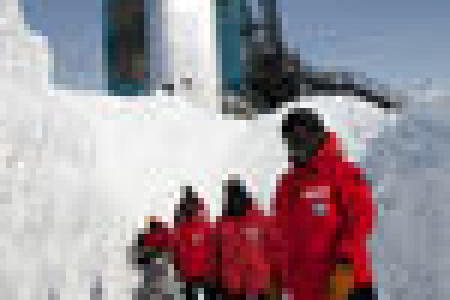
World’s largest neutrino observatory completed at South Pole
Culminating a decade of planning, innovation and testing, construction of the world's largest neutrino observatory was successfully completed today.
100-year study mirrors U.S. history of concrete
Almost since the beginning of recorded history, people have used concrete substances in everything from infrastructure to artwork.
Satellites give an eagle eye on thunderstorms
It's one of the more frustrating parts of summer. You check the weather forecast, see nothing dramatic, and go hiking or biking. Then, four hours later, a thunderstorm appears out of nowhere and ruins your afternoon.
Learning the language of bacteria
Bacteria are among the simplest organisms in nature, but many of them can still talk to each other, using a chemical "language" that is critical to the process of infection. Sending and receiving chemical signals allows bacteria to mind their own business when they are scarce and vulnerable, and then mount an attack after they become numerous enough to overwhelm the host's immune system.
Wisconsin Institutes for Discovery facility opens on UW–Madison campus
Twin research institutes and a space designed for all to engage in science opened Thursday on the University of Wisconsin–Madison campus.
New treatments protect Christmas from ‘Grinch’ grub
Across northern Wisconsin, many of the state's Christmas tree growers struggle to protect their trees from an insect pest known as the white grub, which lurks in the soil, feeds on tree roots and destroys the crop.