
Category Science & Technology
Symposium will focus on developmental biology
When former University of Wisconsin–Madison genetics professor Oliver Smithies won the 2007 Nobel Prize in Physiology or Medicine, he dedicated a portion of his prize money to start a symposium to bring top biologists to campus as a resource for students, faculty, and staff.
Software Assurance Marketplace to host exposition
Top software analysis tool providers from around the world are being invited to run their latest assessment tools at the Morgridge Institute for Research on the UW–Madison campus in a months-long series of tests to improve the quality and security of software assurance tools and open-source software.
Thinking ‘big’ may not be best approach to saving large-river fish
Large-river specialist fishes - from giant species like paddlefish and blue catfish, to tiny crystal darters and silver chub - are in danger, but researchers say there is greater hope to save them if major tributaries identified in a University of Wisconsin–Madison study become a focus of conservation efforts.
Brain can be trained in compassion, study shows
Until now, little was scientifically known about the human potential to cultivate compassion - the emotional state of caring for people who are suffering in a way that motivates altruistic behavior.
IceCube Neutrino Observatory reports first evidence for extraterrestrial high-energy neutrinos
A massive telescope in the Antarctic ice reports the detection of 28 extremely high-energy neutrinos that might have their origin in cosmic sources. Two of these reached energies greater than 1 petaelectronvolt (PeV), an energy level thousands of times higher than the highest energy neutrino yet produced in a manmade accelerator.
Documentary film portrays UW–Madison mindfulness research
MADISON – Groundbreaking research at the University of Wisconsin–Madison is the focus of the new documentary film, “Free the Mind,” which debuts in Madison tomorrow, May 15.
Early career award funds study of messenger RNA stability
In an effort to improve microorganisms that can sustainably produce fuels and chemicals, a University of Wisconsin–Madison engineer is using a U.S. Department of Energy award to study what - if anything - gets lost in the translation of genetic information.
Shakhashiri receives prestigious award for public education
Bassam Shakhashiri, a chemistry professor and William T. Evjue Distinguished Chair for the Wisconsin Idea at the University of Wisconsin–Madison, has received the 2013 Carl Sagan Award for Public Understanding of Science.
Unique engineering shop looks to another challenge of 21st century physics
Sequestered in the farmland near Stoughton, an unusual University of Wisconsin–Madison facility - part machine shop, part design lab, part physics outpost - continues to make machines, equipment and detectors for the world's most advanced experiments.
Adult cells transformed into early-stage nerve cells, bypassing the pluripotent stem cell stage
A University of Wisconsin–Madison research group has converted skin cells from people and monkeys into a cell that can form a wide variety of nervous-system cells - without passing through the do-it-all stage called the induced pluripotent stem cell, or iPSC.
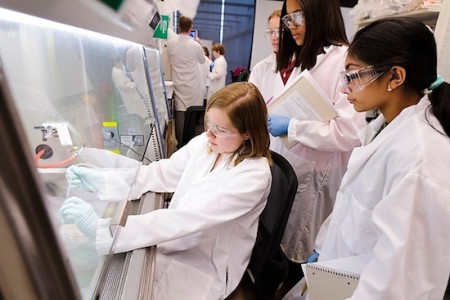
With heart cells, middle schoolers learn the hard lessons of science
The drug trial is not off to an auspicious start. The cells are not cooperating.
UW flu expert elected to National Academy of Sciences
Yoshihiro Kawaoka, a professor of pathobiological sciences in the University of Wisconsin–Madison School of Veterinary Medicine and leading expert on influenza, has been elected to the U.S. National Academy of Sciences (NAS).
UW to offer new virtual internships to enhance women’s interest in engineering
The College of Engineering at the University of Wisconsin–Madison will offer for the first time a course entirely based on digital learning simulations in the fall of 2013.
Vaterite: Crystal within a crystal helps resolve an old puzzle
With the help of a solitary sea squirt, scientists have resolved the longstanding puzzle of the crystal structure of vaterite, an enigmatic geologic mineral and biomineral.
UW physicist works with young Rube Goldbergs at Madison elementary school
The rules are simple, explains Mike Randall, a University of Wisconsin–Madison physicist, who is leading the Rube Goldberg lab tonight at Emerson School in Madison. "Make a contraption that starts by dropping a marble and ends by ringing a bell."
New living, learning community to welcome biology students
To help bio newbies get off to the right start, as many as 130 students will begin 2014 in BioHouse, the university’s 10th residential learning community.
Filmmaker, glaciologist, artist to receive honorary degrees May 17
Honorary degrees will be bestowed on three individuals considered to be pioneers in their fields at UW–Madison commencement in May. One is a groundbreaking documentary filmmaker, another is a trailblazing glaciologist, and the third is a world-renowned glass artist.
Classes in the park unite middle schoolers with college students, nature
Trish O'Kane had reached a dead end. It was her first day teaching a capstone course in environmental studies at the Nelson Institute, and she was ready to forge ahead with a two-hour "college-style" lesson plan.
Madison startup company mounting two-pronged attack against influenza
As a new type of "bird flu" causes deaths and worries in China, a Madison startup is attacking the problem on two fronts. FluGen, under the scientific guidance of University of Wisconsin–Madison researcher Yoshihiro Kawaoka, a world authority on influenza, is moving ahead with a better way to deliver existing vaccines and a novel "universal" flu vaccine.