UW announces inaugural winners of Wisconsin Exchange grants
The projects put ‘pluralism into practice’ across campus, as part of the initiative to help students, faculty and staff learn to engage, live and lead in a polarized world.
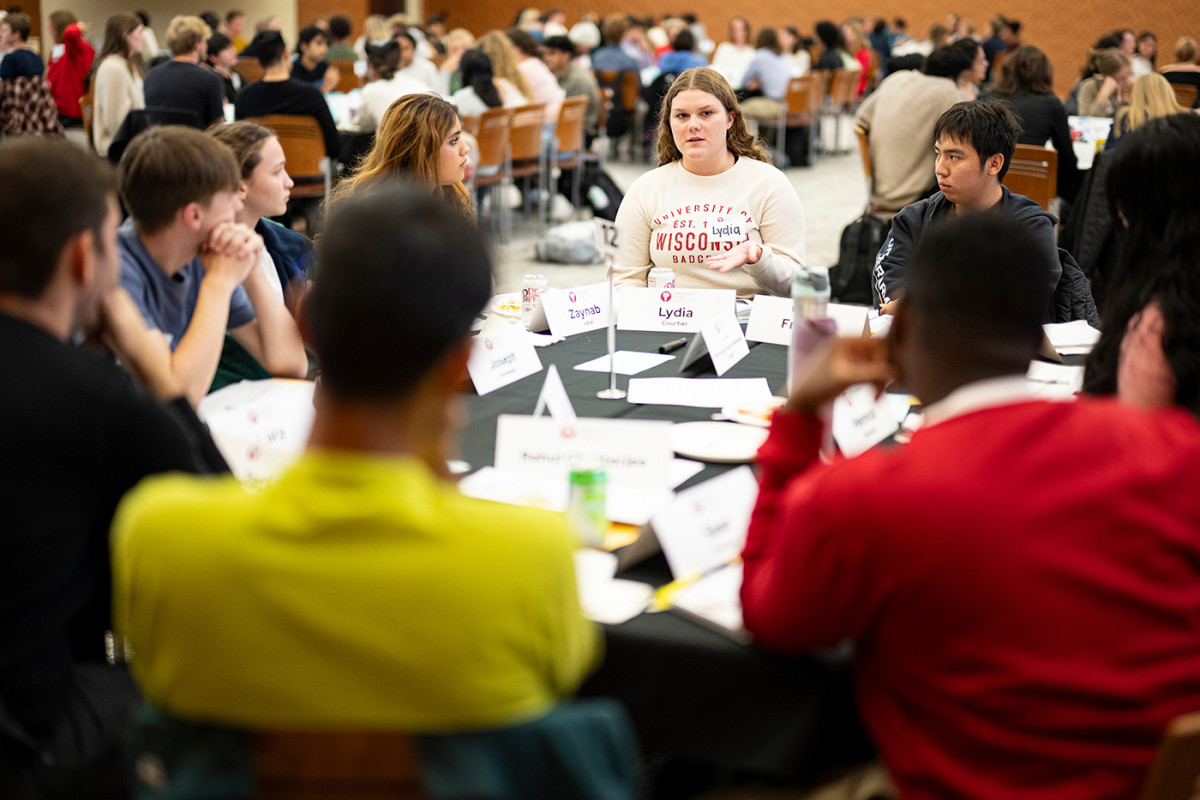
With the launch of a new grant program, the University of Wisconsin–Madison is making its first investments through the Wisconsin Exchange initiative in faculty-, staff- and student-led projects that put “pluralism into practice” across UW–Madison.
The Wisconsin Exchange grant review committee, interim Provost John Zumbrunnen and Chancellor Jennifer L. Mnookin selected the funded projects from more than 40 competitive proposals. The projects span disciplines and units throughout the university and reflect a shared commitment to pluralism and civil dialogue.
Mnookin launched the Wisconsin Exchange initiative in October to help students, faculty and staff learn to engage, live and lead in a polarized world. The effort connects existing programs and cultivates new opportunities to make constructive conversation a visible and integral part of everyday life on campus.
Below are the 2026-27 Wisconsin Exchange grant award recipients:
Student grant recipients
Beyond the Headlines
Courtney Graves
In an era of fragmented media and partisan echo chambers, Beyond the Headlines brings journalists with opposing viewpoints into the same room to model what civil dialogue can look like in practice. This student-organized speaker series pairs writers covering the same contentious issues (such as religion, abortion, and the Israel–Palestine conflict) for moderated conversations that move beyond sound bites.
Classical Foundation Lecture Series
Wisconsin Young Americans for Freedom
Challenging the idea that American conservatism speaks with a single voice, the Classical Foundations Lecture Series plans to bring scholars and journalists with sharply differing views to campus and expose students to competing intellectual traditions within the conservative movement itself. The focus will be on ideas, history and political philosophy as opposed to partisan debate, and inviting students to examine how these differences have shaped — and continue to shape — conservative thought.
Student Employee Forum
Lily Sobczak
The Student Employee Forum creates a structured space for student employees to learn how to lead and communicate across differences. Through a keynote talk and interactive workshops, students practice skills related to empathetic communication, collaboration and change management. By bringing together participants with varied roles, backgrounds and experiences, the forum turns everyday workplace diversity into an opportunity for learning, and it prepares students for constructive engagement in complex professional settings.
What the Fed? Reimagining Civic Engagement with AI
Stephen Li and Cody Ke
UW–Madison’s tradition of sifting and winnowing gets a 21st century update with What the Fed?, a student-led civic engagement platform that uses artificial intelligence to present multiple political perspectives on the same piece of legislation, all grounded in shared primary sources. Rather than offering a single “neutral” summary, What the Fed? makes disagreement visible by showing how different values and priorities shape interpretations of the same facts. The result is a process that turns disagreement into an opportunity for learning.
Wisconsin Ideas Conference: Exchange in Practice Initiative
The Exchange in Practice initiative aims to strengthen the already long-running, student-led Wisconsin Ideas Conference by embedding structured, facilitated dialogue into conference sessions. The project trains student presenters and moderators in constructive engagement across policy differences, ensuring that multiple perspectives are thoughtfully examined in an academic, nonpartisan setting.
Faculty and Staff Seed Grant Recipients
Badger Stories for Civic Health
Center for Community and Nonprofit Studies, School of Human Ecology
Badger Stories for Civic Health connects the Wisconsin Exchange’s commitment to pluralism with the power of storytelling. Through guided workshops, students learn about civic participation and democratic engagement and craft personal stories that reflect how their experiences have shaped their own views and participation. By sharing these stories through live performance and recorded media, the project challenges polarized assumptions, affirms the value of lived experience and creates lasting opportunities for reflection and dialogue across difference.
The Civics & Democracy Collective
College of Letters & Science and Moving Democracy Forward
UW–Madison offers many courses that advance civic learning, but their impact is often isolated. The Civics & Democracy Collective makes this work visible and connected throughout the College of Letters & Sciences. As an interdisciplinary hub, it aligns learning objectives, pilots new curricular frameworks and launches We the People: Voices of Democracy, an entry-level course designed to introduce students to democratic participation and pluralism. Together, these efforts create a coherent and intentional pathway for civic learning across L&S.
Civics Lab
Center for the Humanities
Russ Castronovo and Megan Massino
The Civics Lab asks a deceptively simple question: what is “normal” for democratic dialogue today? The Lab examines how polarization, media technologies and inherited academic norms shape contemporary public discourse. Academic experts are paired with public intellectuals during workshops and public lectures, emphasizing learning across viewpoints and creating opportunities for participants to see civil dialogue take shape in real time.
Civil Discourse Labs
La Follette School of Public Affairs
Living in a state with few competitive electoral districts, many students arrive at UW–Madison without meaningful experience engaging opposing political perspectives. Civil Discourse Labs addresses this gap by creating structured, supported opportunities for encountering principled disagreement. Through teaching assistant training and service-learning–based dialogue labs both in and out of the classroom, students engage with diverse ideas and viewpoints more often and in more places throughout campus, turning civil discourse into a sustained academic practice.
The Wisconsin Values Exchange: Beliefs in Practice Across Professions
School of Law, in partnership with Schools of Pharmacy, Nursing, and Veterinary Medicine
A true cross-campus collaboration, the Wisconsin Values Exchange brings together students from multiple professional schools with different assumptions and forms of training to practice navigating ethical disagreements. Using dialogue and simulations to explore tensions between values, responsibility and judgment, the program prepares students to communicate and collaborate effectively in the sorts of high-stakes professional settings they will soon be entering.
The grant program is just one of many efforts to foster pluralism on campus as part of the Wisconsin Exchange. In addition to a full slate of workshops, symposiums, forums, and speakers already scheduled in the coming months, applications are also being sought for the initiative’s Postdoctoral Fellows Program for 2026-2028.
The program is designed to cultivate a cohort of emerging scholars committed to advancing pluralism and civil discourse within higher education at UW–Madison and across the broader society. Applications are due March 30, 2026.