The world’s best-selling author James Patterson will give this year’s Spring Commencement keynote
The master storyteller, who will deliver the charge to graduates on May 9, shares early advice ahead of the ceremony.
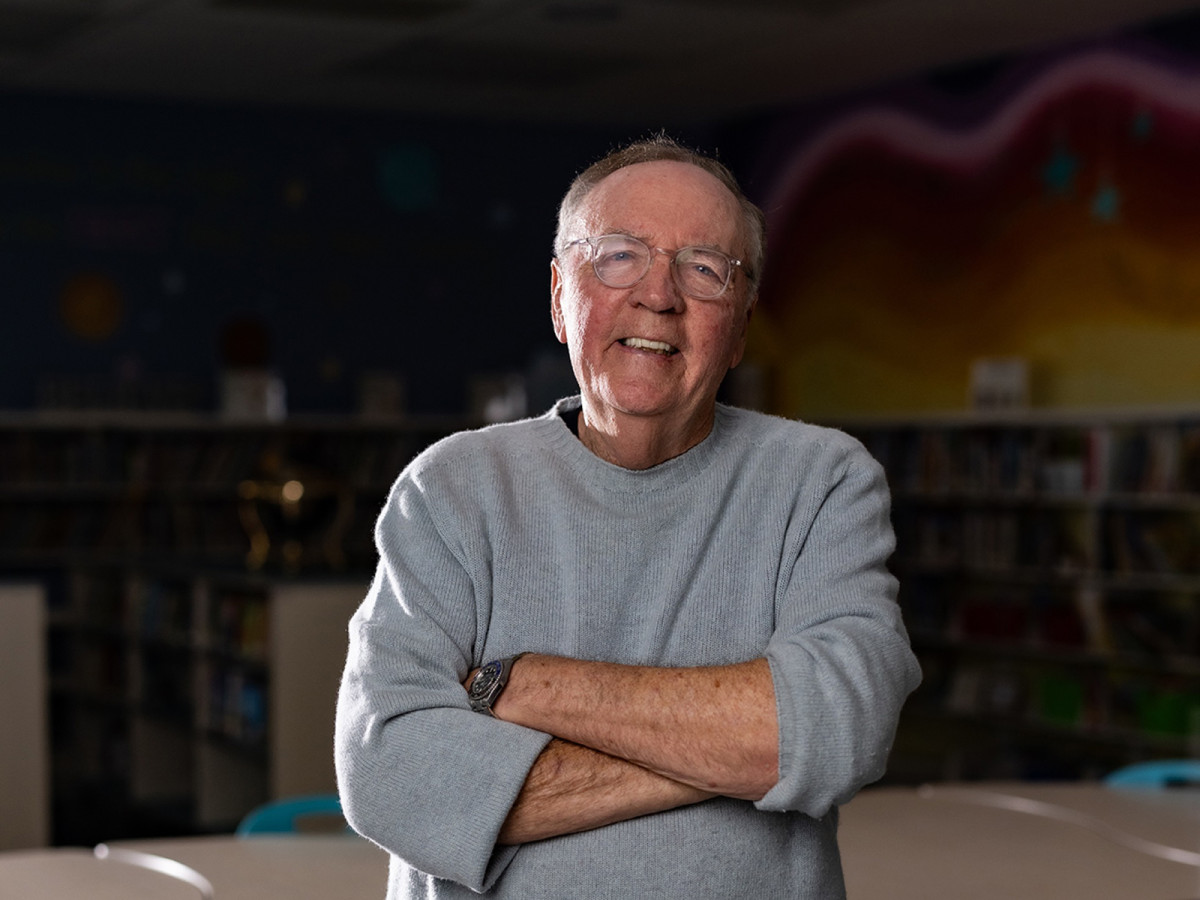
It is hard to oversell James Patterson. He has published more than 250 novels, more than 100 of which have reached No. 1 New York Times bestseller status; sold more than 475 million books worldwide; and co-authored alongside Academy Award-winning actress Viola Davis, former president Bill Clinton and legendary singer-songwriter Dolly Parton.
Patterson has proven himself to be the most popular and prolific storyteller of our time, and this May he’ll help thousands of Badgers close their final chapter at the University of Wisconsin–Madison as the keynote speaker for the Spring 2026 Commencement ceremony. He’ll offer his remarks for all bachelor’s, law and master’s degree candidates on Saturday, May 9, at Camp Randall Stadium.
Patterson’s debut novel, “The Thomas Berryman Number” (1976), won an Edgar Allan Poe Award, but he received his breakthrough with the novel “Along Came a Spider” (1993), featuring detective Alex Cross. There are more than 35 books, so far, in the Alex Cross crime thriller series, as well as three major motion pictures based on the crime-solving character. A television series has recently been renewed for a third season.
His other popular works span an impressive range of genres and audiences, including the young adult science fantasy novel series “Maximum Ride;” “Women’s Murder Club,” a mystery series featuring four female protagonists that has been adapted for television as well as several games; and his “Middle School” series, geared toward children aged 8 to 12.
Patterson has also received 10 Emmy Awards, an Edgar Award, the Literarian Award from the National Book Foundation, and the National Humanities Medal.
But Patterson, who graduated summa cum laude with a B.A. in English from Manhattan University and with an M.A. in English from Vanderbilt University, is more than a writer. He’s also a fierce advocate for education.
Along with his wife Susan, a UW–Madison alumna, he has donated more than $240 million to literacy-focused programs and endowed some 5,000 college scholarships for teachers. Here at UW–Madison, the Pattersons provide scholarship support for more than 150 students each year.
“James Patterson has shown what it means to make the most of your education — and what it means to give back. We are thrilled to welcome him as this year’s commencement speaker,” says UW–Madison Chancellor Jennifer Mnookin. “His successes as a writer are unparallelled, and so is the generosity of his time, talent and resources, which have made lasting impacts on higher education and the lives of countless students.”
But before all of his successes, he was just like the thousands who will walk the stage in May — a college grad ready to take on the world.
In a recent interview, Patterson offered a preview of the wisdom he will share with the Class of 2026, including the importance of storytelling and being open to changing your own ending.
You’re a writer. Everything you do starts with a blank piece of paper. What is it like to stare at that empty page?
It means everything to me. I start with an outline. I’m a big outline person. I’m not a slave to the outline though, I’ll change things. But that means when you’re ready to write the book, you’re not looking at blank pieces of paper. I’m always open to changing everything and I always do, especially the endings … Have a general idea but be open to change. And look, don’t work for a living. Quit, just quit if you are. I don’t work for a living. I play for a living. My time here is short. I am continually asking myself, “What can I do most beautifully?” That’s how I choose what I do.
You’re a storyteller. Why is story important?
For starters, whatever it is, whether it’s the university or a corporation or an individual, the story is going to either move you forward or move you backward. Take Wisconsin. You get goofy things that people will say about the state, the cheeseheads and all that, but that’s not the ideal story. The state has this university. And it really is a superior university. It is as good as any school in the Big Ten.
It’s funny. We have a hard time telling our own story.
We all have a story. But whatever the story is, it must be your story. And certainly not the story your parents decided your story was … That’s a huge thing that students need to consider. They need to be open to writing it and they need not to be afraid. Have a dream. Dreams can happen. They need to be somewhat realistic, you know, and have a backup plan.
And I think it’s useful to have mentors. My mentor was my grandmother. She didn’t go past 6th grade, but she was brilliant. And her thing with me was that you can be anything you want to be, including being a writer, which seemed ridiculous, coming out of our hometown. She would use various lines like, “hungry dogs run faster.” Which I believe. And you know, at my age, I’m still a hungry dog. I am hungry. I’m always trying to grow.
And that dream you mentioned, the education, the culture you get from college should be bigger than you. That you should do something with it.
Absolutely, the whole philanthropy thing is important to me and my wife. We’ve been given a lot, so we give away a lot. And that was drilled into me by my mother and grandmother. Give it away. Do things that are going to help people in some way, shape or form. Build the habit now.
Any parting wisdom for the graduates?
The only thing I would say to them is that if you’re nodding your head yes, forget about it, because you already do that. If you want to get better, it’s going to be because you’ve changed, so do the stuff you shake your head no at. Because those are the things you aren’t doing. And you can’t change by doing what you’ve already done.
I don’t want to lecture about how students should live their lives. Just keep asking, “Is this a beautiful thing or just a shiny object?”
The interview was edited for brevity and clarity.