A movie about war, college football and two heroic Badgers
‘The Mosquito Bowl’ opens in theaters this weekend with a re-creation of UW–Madison’s Camp Randall in the 1940s.
Loud, slushy and packed with fans, a Badger game at Camp Randall Stadium in the 1940s — or at least a re-creation of it — is the backdrop for a defining moment in the new movie “The Mosquito Bowl.”
The two-hour feature film, based on author Buzz Bissinger’s 2022 nonfiction book “The Mosquito Bowl: A Game of Life and Death in World War II,” is set for release in select theaters on Friday, Oct. 30 and on Netflix starting Nov. 25. Based on true events during World War II, the story follows four of America’s top college football stars — John McLaughry of Brown University, Tony Butkovich of Purdue, and Bob Bauman and Dave Schreiner from the University of Wisconsin — as they join the Marines and head to the Pacific Theater following the attack on Pearl Harbor.
Over time, the four sports rivals bond, not just through football, but through the sheer effort to survive on the battlefield. Like Bissinger’s book, the R-rated film does not shy away from depicting the gruesome and bloody horrors of war in detail.
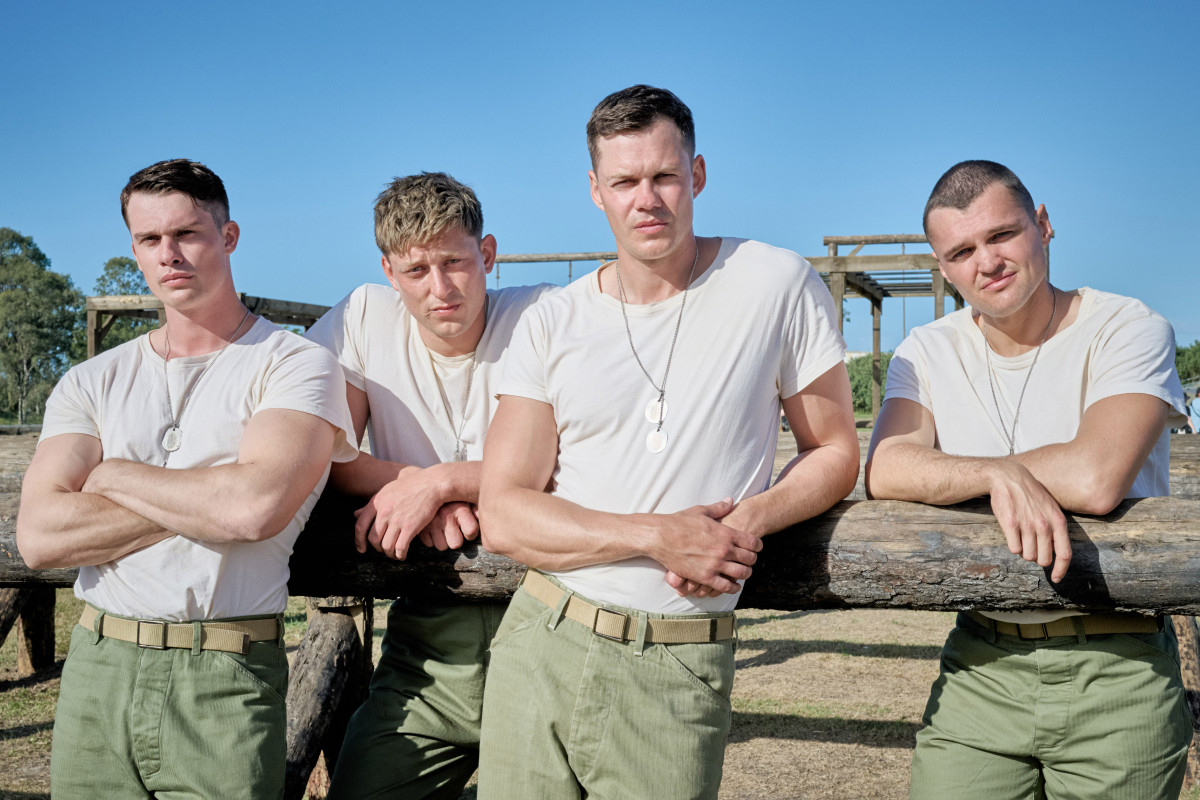
“The Mosquito Bowl” is directed by Peter Berg, who also brought Bissinger’s best-selling book about a Texas high school football team, “Friday Night Lights,” to the screen.
“Buzz has a way of taking something like football and using it to look at American culture in a very soulful, poetic way, where he explores themes of family, and culture, and education, and love, and victory, and loss — and he weaves it into a football story,” explains Berg, who is Bissinger’s cousin. “So when he was (first) telling me about ‘The Mosquito Bowl,’ I knew that it was going be more than just a football movie (or) just a war movie.’”
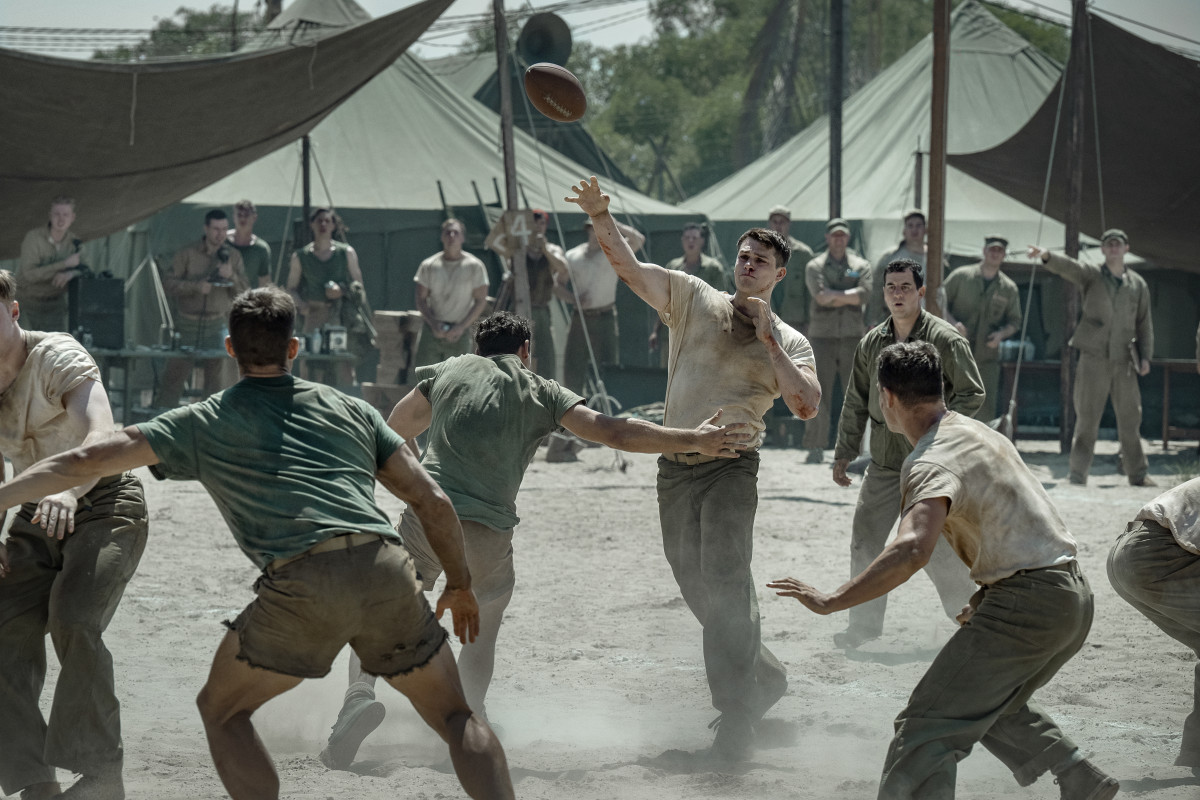
The new film’s title comes from a little-known football game played by U.S. Marines on the island of Guadalcanal on Christmas Eve, 1944, as they prepared for the invasion of Okinawa — a brutal, months-long battle that would leave some 12,000 Americans, 90,000 Japanese combatants and 150,000 Okinawan civilians dead.
The so-called Mosquito Bowl offered a rare moment of joy for both players and the regiments who cheered them on. Outfitted in military-issue T-shirts and fatigues, competing on a field of dirt, pebbles and shards of coral, the opposing teams included three All-Americans, seven former college captains and other young standouts from across the country.
The story of the Mosquito Bowl was personal for both Bissinger and Berg. “Buzz’s dad was a Marine in Okinawa. My dad was a Marine in Korea. So there was a strong connection,” says Berg. “I was raised with a deep understanding of what the Marine Corps meant to my father, and I think that was an added reason I wanted to make (the film). It is a story about the human sacrifice and the cost of war — which, to me, is a sacrifice that we cannot look at enough.”
While the film’s brutally realistic battleground scenes were filmed in Australia, some exterior shots were done at Brown University and key scenes, down to the replica Wisconsin Badgers uniforms, were filmed to evoke a football game at UW–Madison’s Camp Randall.
“I wanted to try and bathe the audience and the emotions of the time,” says Berg. “So when we’re filming college football in 1940s, Purdue versus Wisconsin, I wanted to capture the spirit of what it meant to play football, or go to a football game, or be caught up in the kind of spirit of college football.”
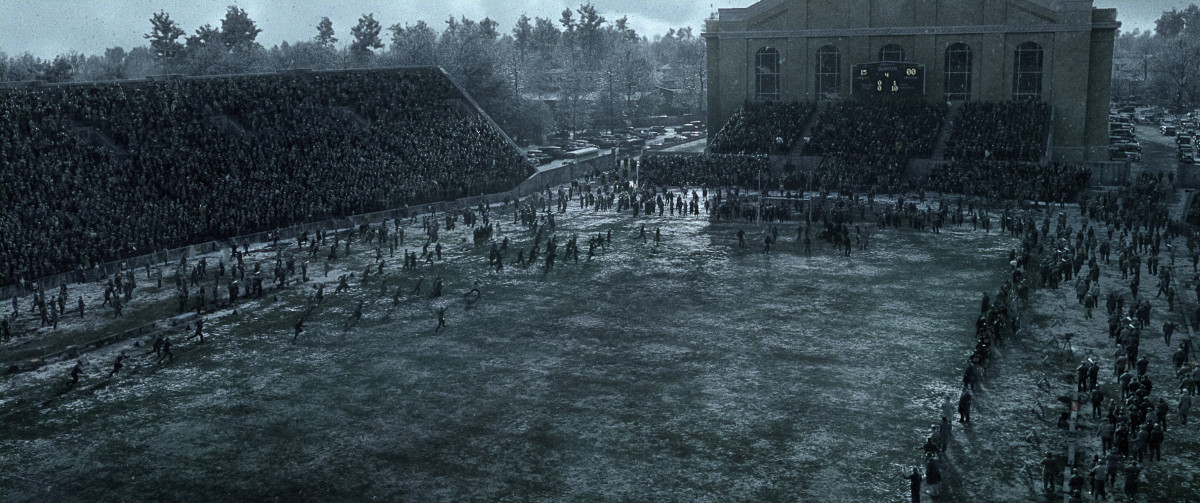
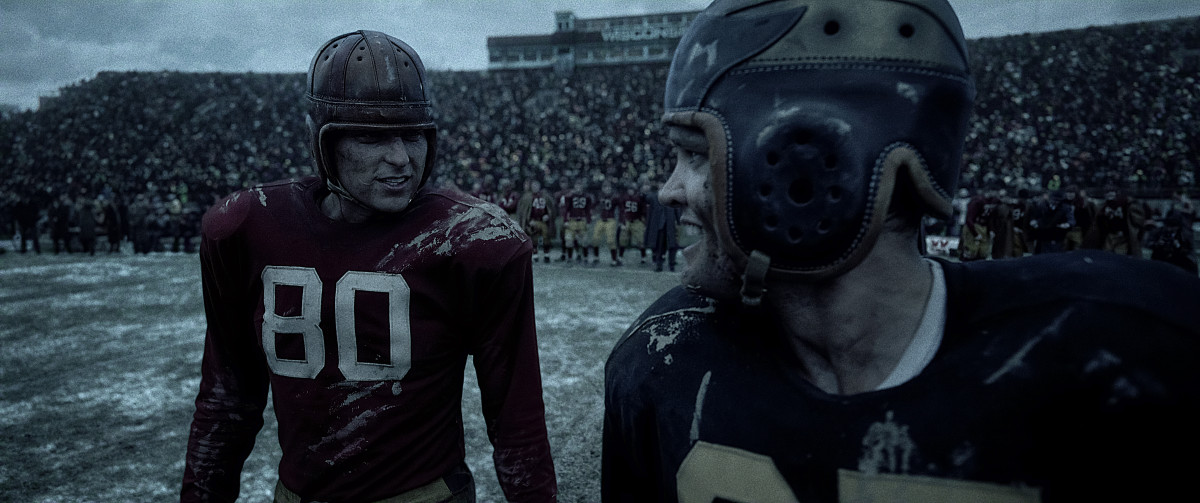
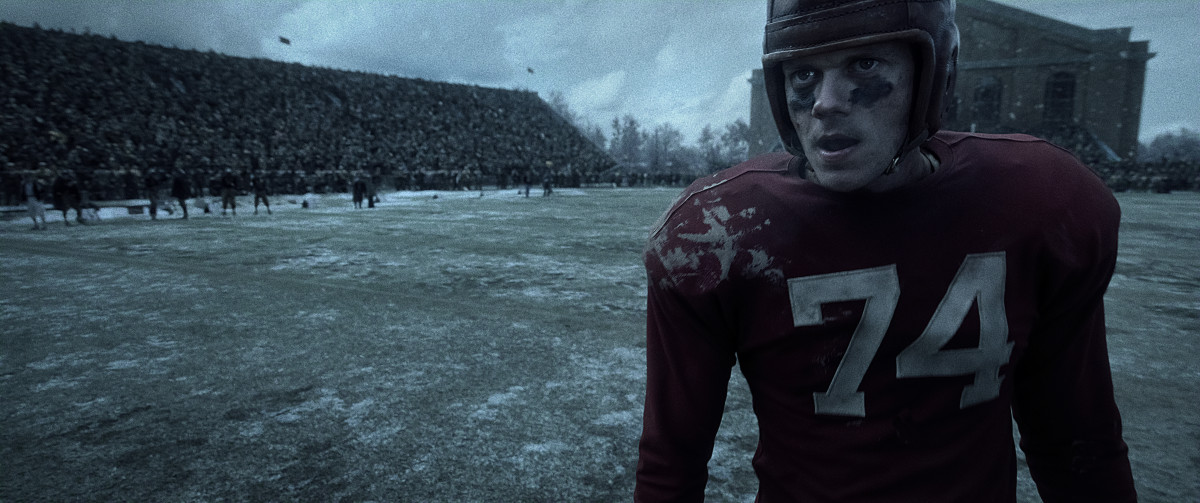
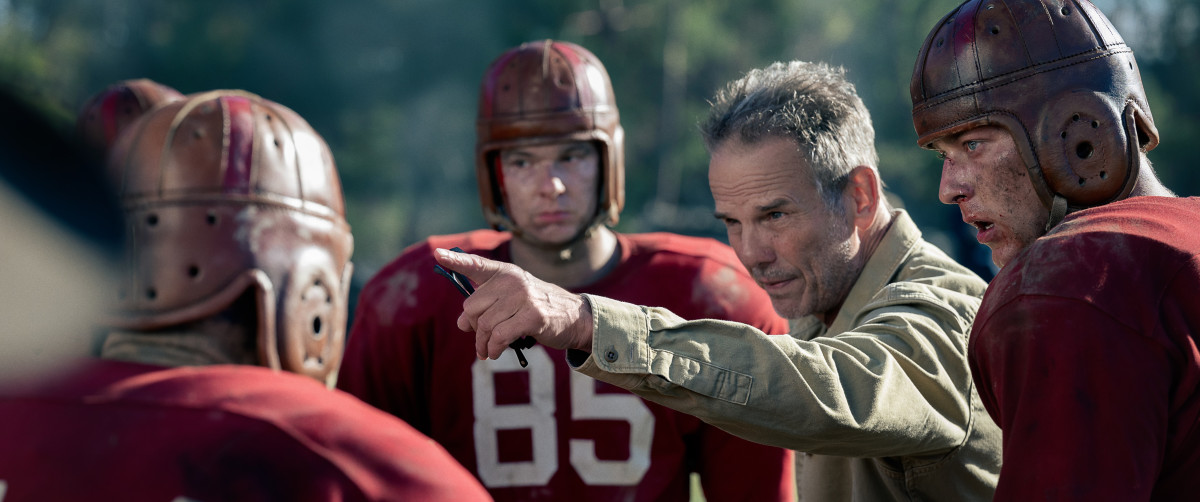
“We re-created Camp Randall with the exception of one overhead shot of the stadium,” that he says was made using a historic photograph, LIDAR scans and “a little movie magic.”
“The Mosquito Bowl” includes a full cast of Hollywood heavy hitters. Bill Skarsgård and Tom Francis star as Badgers and best friends Bauman and Schreiner, respectively. Both football players had been drafted by NFL teams ahead of their deployment. Bauman and Schreiner were in the same Marine company and died in action just weeks apart in June 1945. Nicholas Galitzine plays Brown linebacker McLaughry and Ray Nicholson rounds out the title characters as Butkovich, the fullback from Purdue.
In the week leading up to the film’s release, Berg visited the College Football Hall of Fame in Atlanta. “If you walk through this building, which I highly encourage anyone to do, you feel the spirit — not necessarily of football, but of humanity,” he says. “There’s a power in this building.” Upstairs, “there’s a section dedicated to Dave Schreiner of Wisconsin. I just went up there and got emotional looking at it, thinking about what college football means to this country. To anyone who experienced it, it’s much more than a game.”