UW’s Nobel laureate started his research with a question
In an opinion piece for the Milwaukee Journal Sentinel, interim Chancellor Eric Wilcots makes the case for giving researchers the resources necessary to pursue answers to curiosity-driven questions.
This opinion editorial written by interim Chancellor Eric Wilcots originally appeared in the Milwaukee Journal Sentinel on Nov. 4.
For the first time in more than 50 years, Wisconsin is celebrating a Nobel Prize from one of our own. It’s an extraordinary scientific achievement. But the story behind this honor is equally compelling — and instructive — particularly at a time when the research enterprise that made it possible is being scaled back nationally.
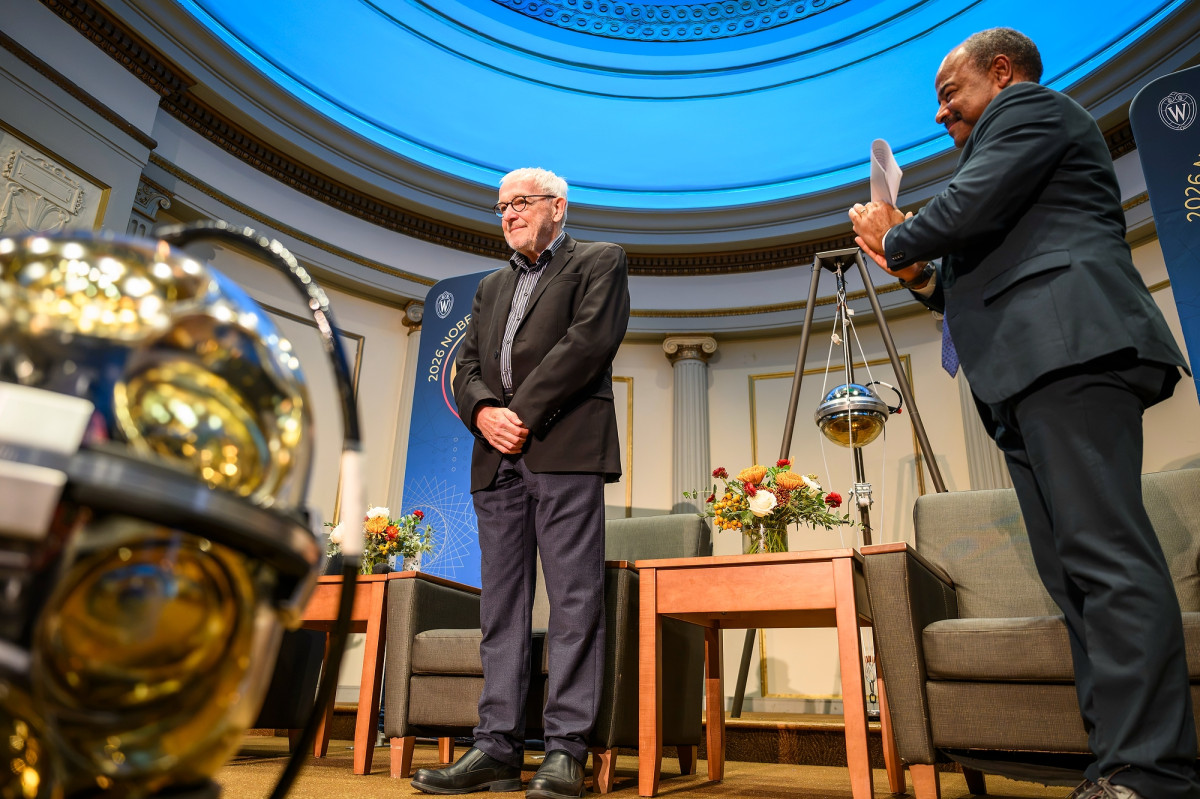
Francis Halzen and the IceCube Observatory’s story — like all curiosity-driven research — started with a question: How can we detect the invisible ‘ghost particles’ called neutrinos that pass through the Earth every second and unlock their secrets?
For centuries, scientists have studied light from distant galaxies to understand the universe. But neutrinos — tiny messengers from the darkest reaches outer space — carry clues that light can’t reveal. The challenge is detecting them.
Halzen, a UW–Madison physicist and 2026 Nobel laureate, had an audacious idea: Bury thousands of sensors a mile deep in arctic ice to capture the tiny flashes of light produced when a neutrino smashes into matter. And then analyze those flashes to decipher the ghost particles’ messages.
Many said it wouldn’t work. Halzen, himself, had doubts. But he saw a path to discovery that others couldn’t. And UW–Madison, which has long invested in curiosity-driven research, supported him.
Unlike applied research, which seeks to solve a specific problem, curiosity-driven (also often called “basic” or “pure”) research seeks only to understand more about how the world works.
Road to discovery is often long and unpredictable
The road to discovery in this case is often long and unpredictable. But it’s also a pursuit of knowledge that can change our understanding of the world and how we live in it.
At UW–Madison, it resulted in understanding that Vitamin D could cure rickets. It produced the Babcock butterfat test, which transformed dairy production. It led researchers investigating a mysterious bleeding disease in cattle to create warfarin, one of the world’s most widely used blood thinners. And our last Nobel Prize winner Howard Temin, forged a path to gene therapies and anti-cancer drugs that have saved countless lives by asking why viruses cause cancer in chickens.
Decades of federal investment in curiosity-based research made the U.S. a global leader in innovation. But as that investment declines, other nations are catching up, and in some areas, even surpassing us. Universities like UW–Madison face deep uncertainty as federal support for research is cut. The impact slows the pace of discovery, weakens our ability to develop the next generation of scientists and engineers, narrows the pipeline of ideas flowing into the private sector, and ultimately, makes our nation far less competitive on the global stage.
As federal investment declines, other nations catching up to US
This past summer, the White House issued a report that prioritized federal research funding for projects geared toward commercialization and applied research. At first glance, focusing resources on solving today’s biggest challenges might seem reasonable. But every project that might now be ready for commercialization or be applied likely began as curiosity-driven research years or even decades ago. And, it is the desire to understand the world around us — our curiosity — that makes us fundamentally human. The profound value of curiosity-driven research often lies in what it makes possible for generations to come.
It’s impossible to know what or who might produce tomorrow’s Alzheimer’s breakthrough, the next lifesaving cancer treatment, or a technology we cannot yet imagine. But we do know that companies cannot commercialize discoveries that have never happened. And because of their investment and belief in curiosity-driven research, those discoveries are most likely to come from the nation’s universities.
Today, at UW–Madison, and campuses across the country, the next Francis Halzen is busy pondering a question that could someday change the world. We must continue to value that curiosity and give researchers the resources necessary to pursue the answers, wherever they may lead.