Interwoven
How Indigenous knowledge and science can work together to communicate about climate.
As a child, Sherri LaChapelle-Corn spent a lot of time in the forest. It inspired a lifelong fascination with the shapes and designs found in pieces of wood. Peeled bark, a twisted branch, patterns on a trunk all became canvases for a painting, materials for a new sculpture, or simply interesting artifacts to bring home and admire.
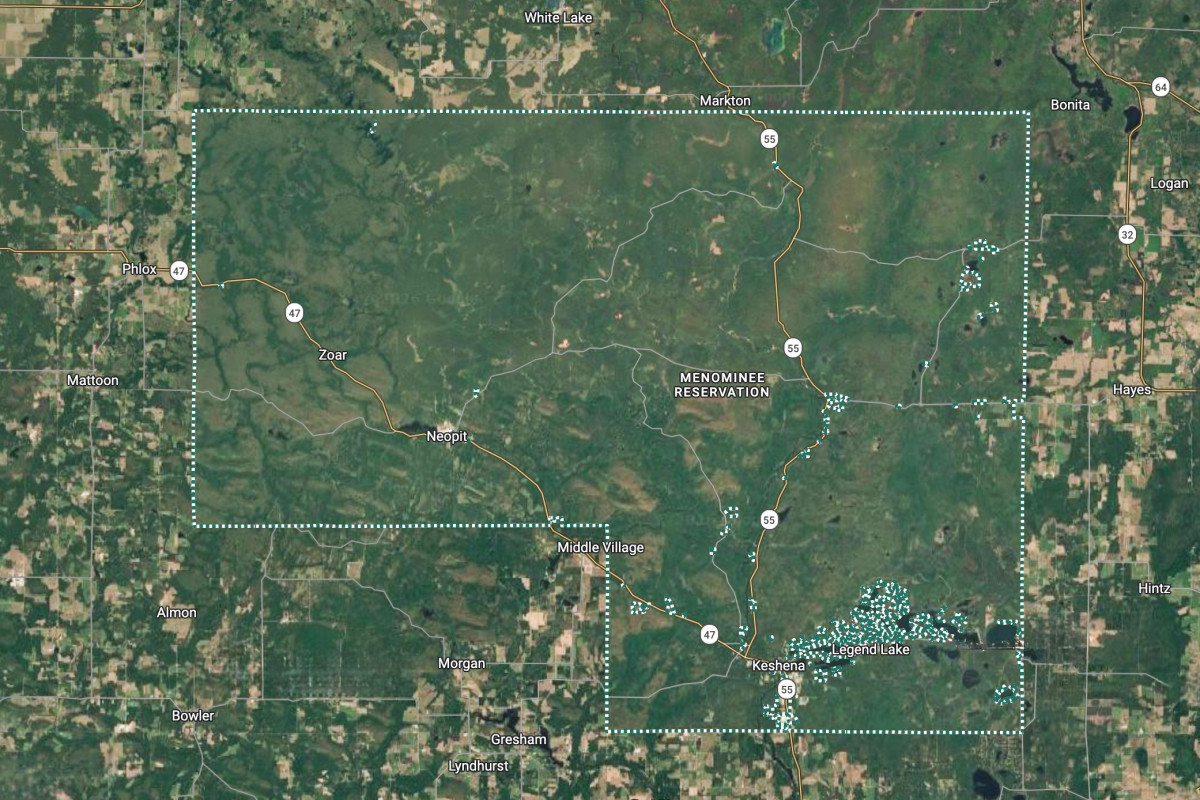
The forest she grew up in is also the center of her northern Wisconsin community, providing not only its major economic engine through the timber and logging industry, but also the basis for their shared identity. Of the 235,000 acres that make up the Menominee Reservation, 93% is forested.
Culture isn’t the first thing people tend to associate with environmental issues. For this Menominee basketmaker, though, it’s all too familiar a connection.
“We, the Menominee, are the forest keepers,” she says, adding that their forest and management practices are well-known, respected and studied by foresters from around the globe. Today, satellite images show the Menominee Forest as a dense, dark green rectangle surrounded by patchy or completely clear-cut farmland.
LaChapelle-Corn, who prefers to go by Pītapanukiw — or Pitap for short — is now 69 years old and still loves to work with materials from the forest. Her favorite is working with black ash trees to weave intricate baskets using techniques Menominee weavers have passed down for generations.
“It’s so cool that you can make a beautiful thing out of that gift from that tree,” Pitap says. “Whoever learned how to do all that process is just amazing to me, and the knowledge is 10,000 years old.”
But this way of basketmaking may not be possible for much longer, due to the unwelcome invasion of a small green beetle: the emerald ash borer.
“They’re nasty little bugs,” Pitap says. “How can a tiny little bug destroy something so beautiful that’s been growing for many years, and just by boring its hole in there?”
“When you go to a bigger grove, every black ash tree is just wiped right out, like 90%,” says Adam Waukau, a Menominee forester who grew up working in the logging industry here. He also helps harvest suitable black ash trees for Pitap to use in basketmaking.
The emerald ash borer arrived in Wisconsin in 2008 and was first detected in Menominee County in 2022 along with its devastating effects. Freezing winter temperatures once helped keep the ash borer population in check, but as milder winters become more common, the beetles can survive by boring under the tree bark. Menominee foresters predict the black ash tree will disappear in as soon as two years.
Going out to harvest a black ash isn’t as simple as going to cut your own Christmas tree from a field of precisely planted rows. The black ash is just one tree intermixed in the larger ecosystem of the forest, and the Menominee’s knowledge of that interconnectedness is part of why their forest management has been so sustainable and successful.
“When people ask about going to get ash trees, it’s pretty confusing for anybody that really hasn’t been in the woods,” Waukau says. “It’s traditions, not just a job. This is what we do. This is how we do it, and this is why we do it — and it boils down to respect for the earth.”
Walking through the dense hardwoods, Waukau looks for black ash that are old enough to have spread several seasons of seeds, with large enough trunks to maximize the volume of wood strips that can be processed for basketweaving. It’s a task that relies on centuries of knowledge, but now Waukau also must keep an eye out for signs of damage by the emerald ash borer.
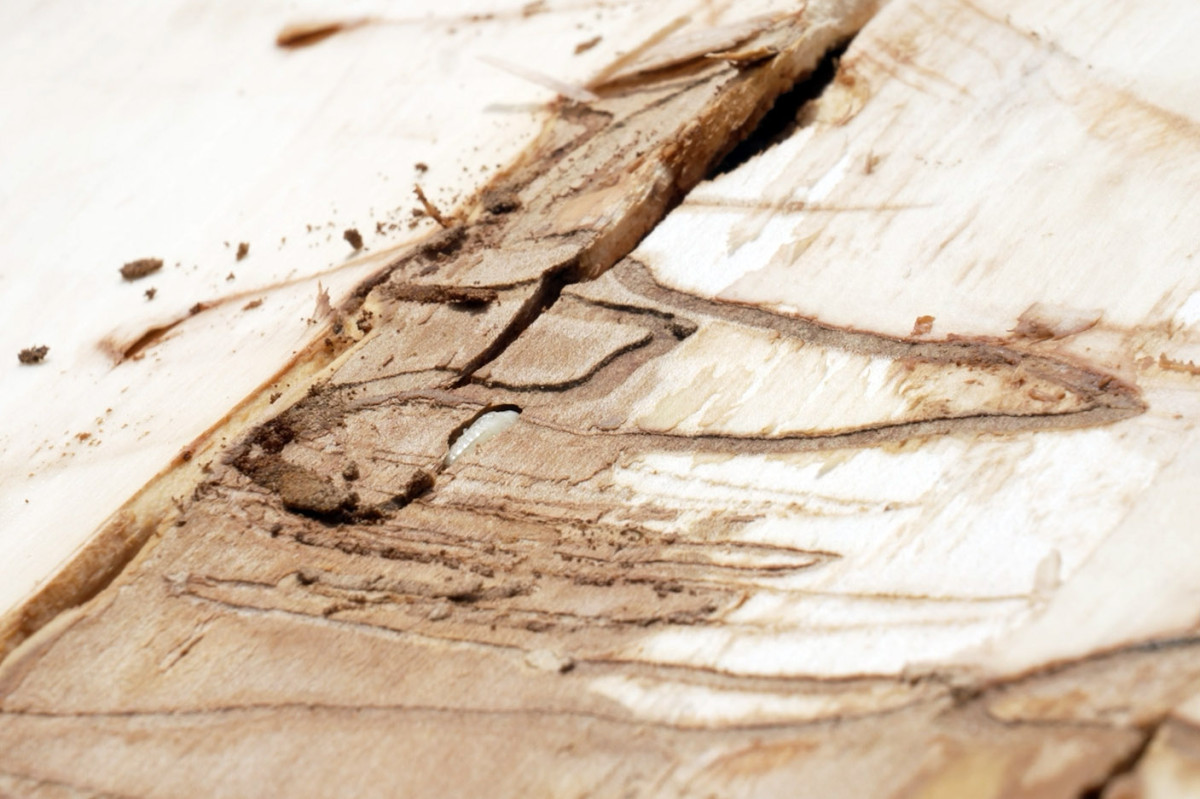
Sometimes patches of bark fall completely away on trunks and reveal the damaged trails left in the wood by the hungry bug. But other times a tree seems unaffected until the basket makers peel off the bark of a harvested tree and get a look at the damaged layers beneath.
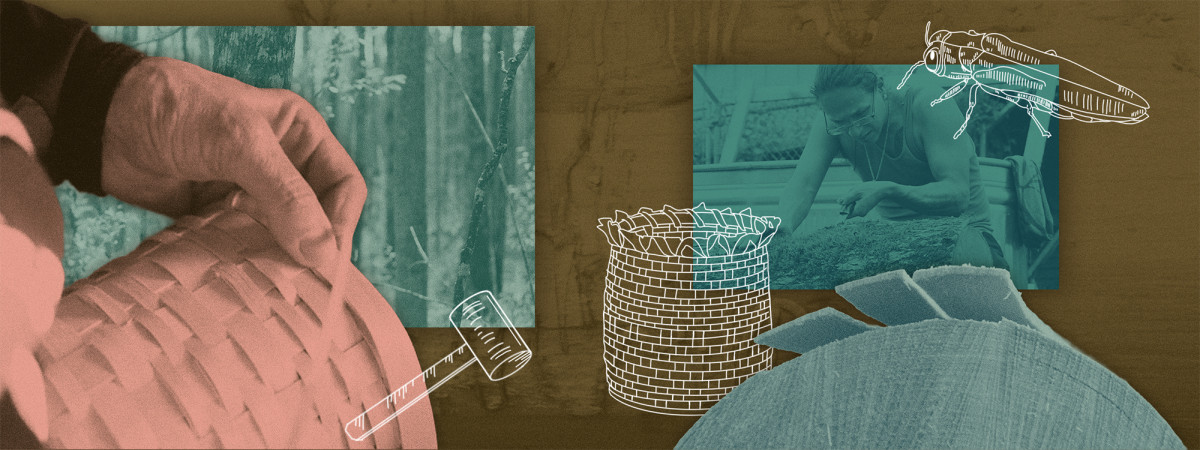
Normally, a harvested log could be soaked in water and pounded with mallets until, layer by layer, strips of the trunk begin to peel off. Pitap can then scrape, split and trim those strips of wood to various widths and weave them together into baskets. But when the emerald ash borer leaves discolored trails of pulpy mush behind, it rots the layers of wood that could have become baskets.
“I think about the loss that’s going to happen. It worries me,” Pitap says. “With Nan Li’s grant, it really helped because we could save more raw material, plus teach and have classes.”
Nan Li is a professor of life sciences communication at the University of Wisconsin–Madison. She learned about the Menominee reservation’s emerald ash borer problem from UW–Madison professor of community and environmental sociology Annie Jones, who is also an enrolled member of the Menominee Indian Tribe of Wisconsin.
“Nan has a real passion for science communication and the intersection with art,” says Jones, who is also a professor in the Division of Extension. “It just kind of all gelled where we were all looking for some opportunities to do some important work together.”
With Li’s help in securing funding through various grants, Pitap can provide payment to Menominee foresters who harvest the black ash and to Menominee youth for the hours of arduous labor it takes to pound the logs into raw weaving strips.
It also helps her facilitate workshops where she can teach Menominee youth and other interested individuals how to use these materials to weave baskets by hand.
“I’ve never thought about climate change affecting our traditional practices until this invasive species hit, or the changing of the weather, because everything is affecting the forest,” Pitap says.
Once the strips have been pounded from the tree, they are scraped, cut and shaped into spokes and weavers to construct a basket.
Now, Pitap is focused on harvesting, preparing and storing as much raw material as possible to save it for future generations.
While the main objective is to support Pitap’s work, Li is also developing a research project connected to their efforts. Li wants to see how reframing the environmental changes through a cultural lens — the loss of black ash basketmaking — will influence people’s perception, understanding and willingness to take further action.
Li believes effective science communication is about more than presenting scientific evidence and data on their own.
“We need to deliver that information in a way that makes sense to people,” she says. “I think participatory artistic activities create a very unique forum for people to be part of.”
Li and the student researchers in her lab survey participants at Pitap’s workshops and beyond. They document responses to three different messages about the emerald ash borer, with half of the stimuli paired with photos of black ash baskets crafted by Pitap.
One message focuses on the economic impact of the damage done by the bug, another focuses on the environmental effects, while a third focuses on the cultural loss.
They want to see if pairing the messages and baskets together influences people’s willingness to take further actions, such as replanting black ash trees or building up seed banks so in the future, the trees could be brought back.
It’s traditions, not just a job. This is what we do. This is how we do it, and this is why we do it — and it boils down to respect for the earth.
When people think about climate change, they’re thinking about things like rising temperatures, changing sea levels, drought and famine, Li says. That’s likely because the messages they’re seeing every day focus on those environmental effects. Culture is a piece of the puzzle Li thinks is missing from this conversation.
“This case demonstrates there is much more at stake. When we no longer have these trees … we’re losing such an important piece of culture that grows out of this land,” she continues. “I think that’s something people need to know more about to not just preserve the environment but really save the culture that defines the people on this land.”
For Jones, projects like this give her an opportunity to honor her relatives while being in community with fellow Menominee. Weaving workshops offer a space to practice Menominee language, to learn from one another and share stories about how the forest has changed over time. Jones describes that opportunity to be in community while sharing cultural practices as healing.
“I really think of Indigenous people on this land as being our first longitudinal researchers,” says Jones. “Rather than pushing off the knowledge or discounting the knowledge, wouldn’t it be great if we could continue to learn from Indigenous people about how to take care of a place and conserve it for generations to come?”